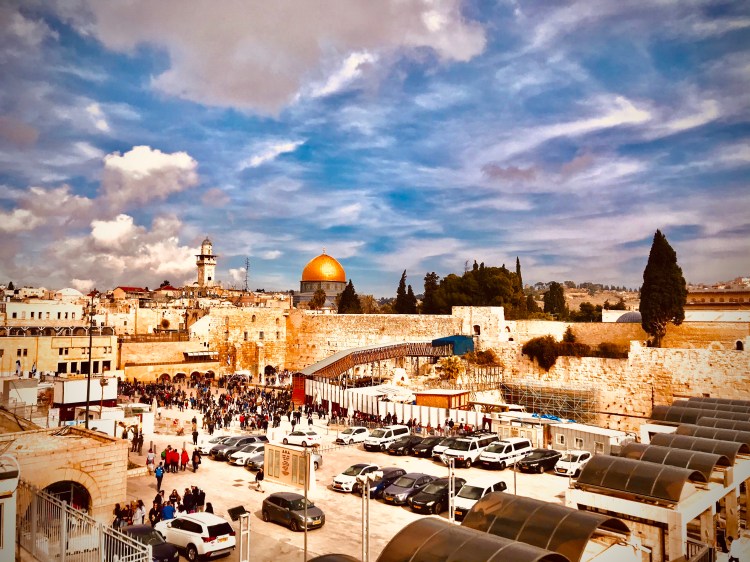
 Jerusalem. I’ve had so many thoughts about this city throughout my life. As do most people in this world. Whether Jew, Christian or Muslim, it holds a central significance to one’s religion. Even those who don’t follow these faiths can acknowledge how Jerusalem holds an important space in history. That is why I had to see it.
On our last full day in Israel, we took a cab to Tel Aviv’s Ha’Hagana station where we took a 45-minute train ride to Jerusalem.
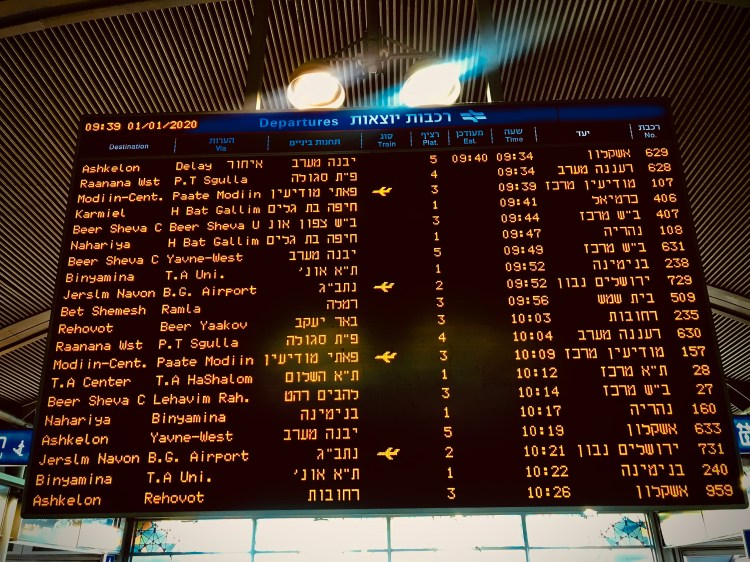
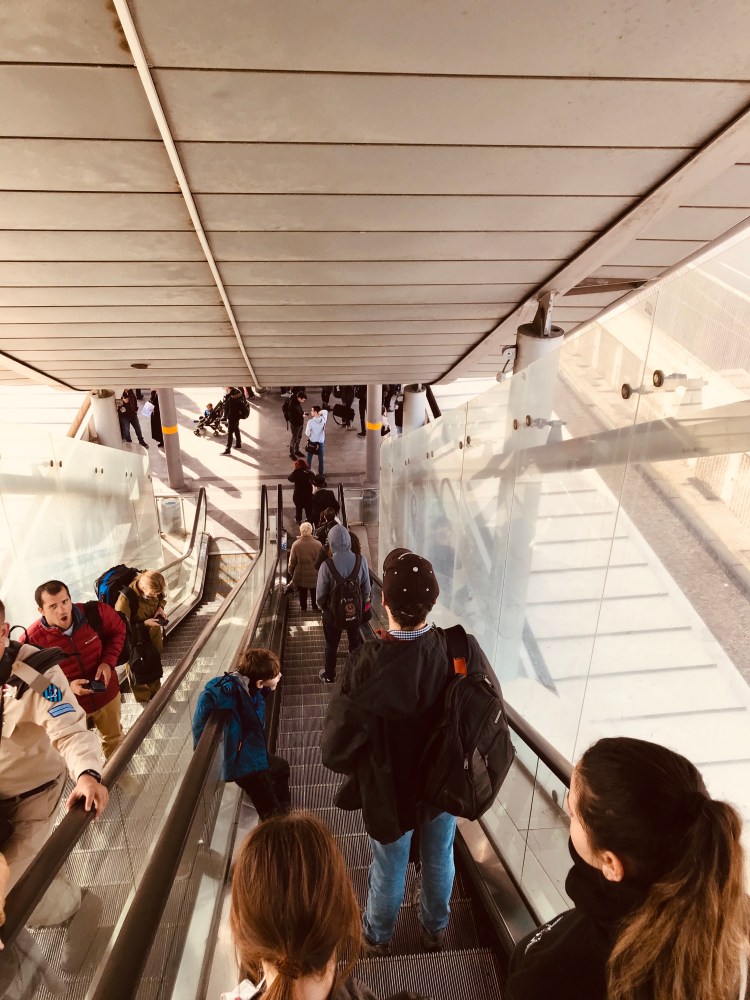
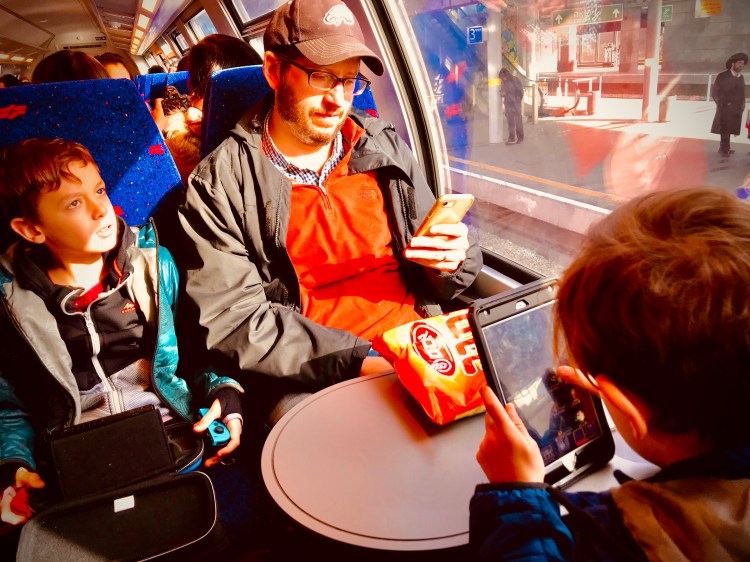
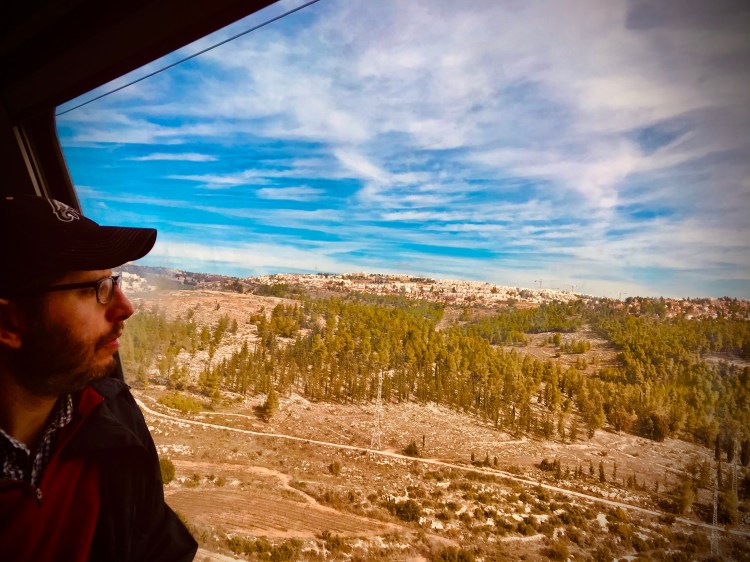 {Taking the train from Tel Aviv to Jerusalem}
After we arrived at the Jerusalem train station, we rode three of the longest escalators I’ve ever seen to emerge to the street level.
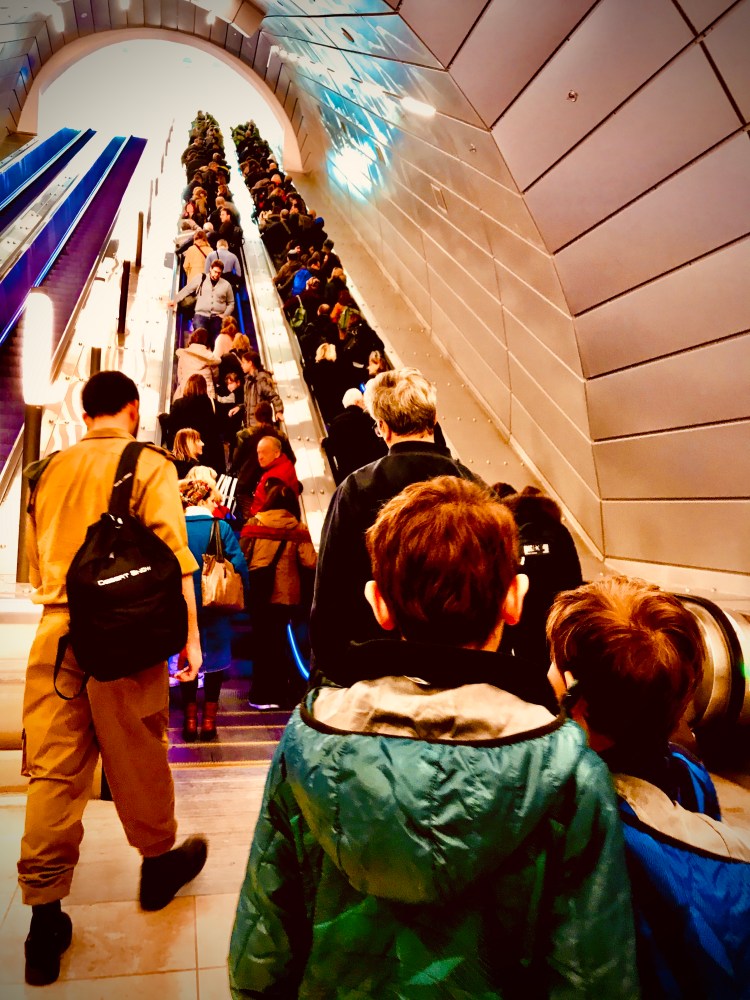 {Longest escalator the boys, or even I, had ever seen}
We then took a tram to the Old City which brought us to the Damascus Gate, one of the twelve gates through the city wall. The Damascus Gate is known in Arabic as Bab el-Amud. At its foot are the remains of a gate and plaza dating from the Roman period.
The entire journey took over two hours. Whew!
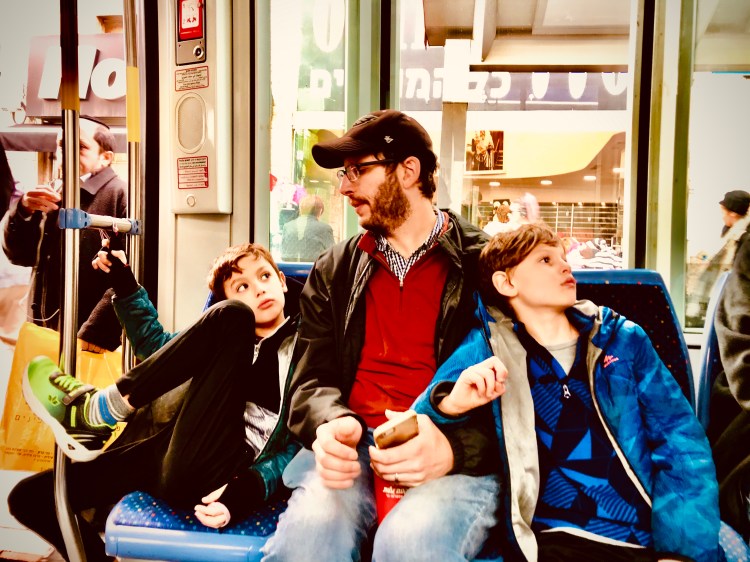 {Tram in Jerusalem}
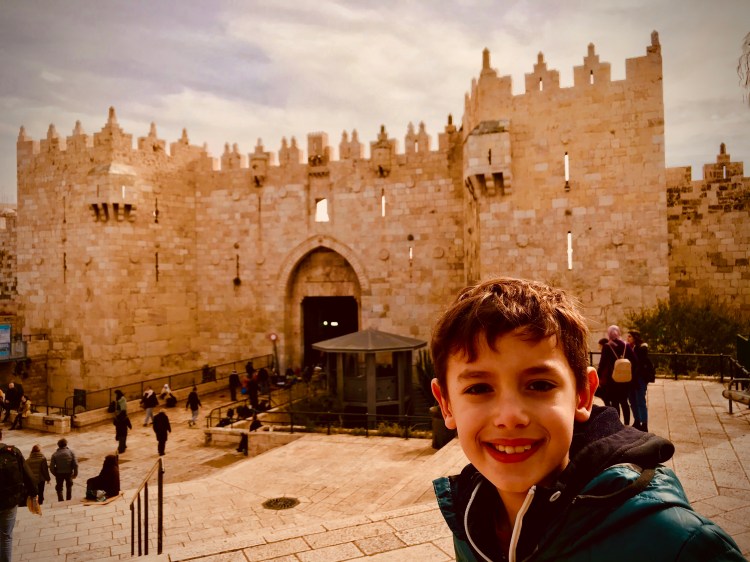
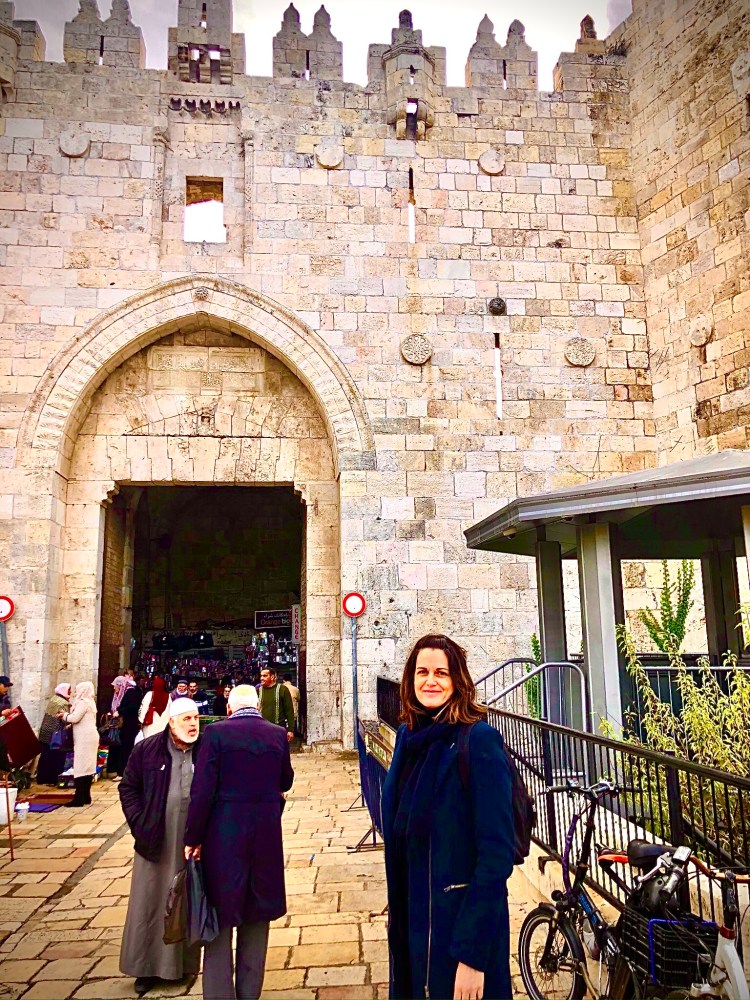
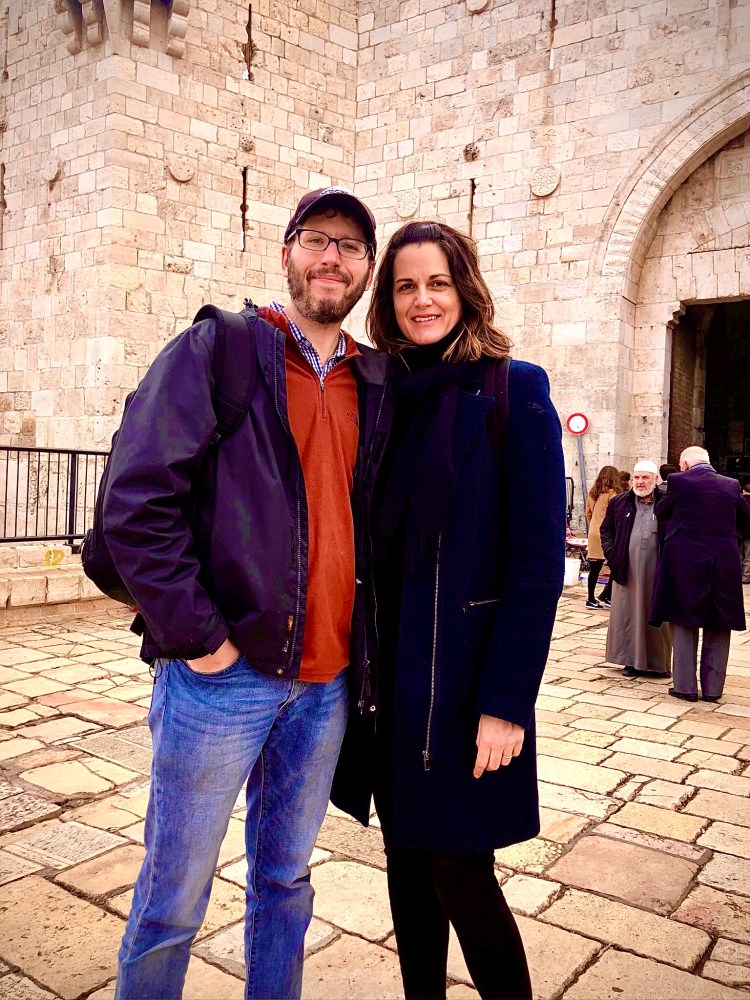 {At the Damascus Gate}
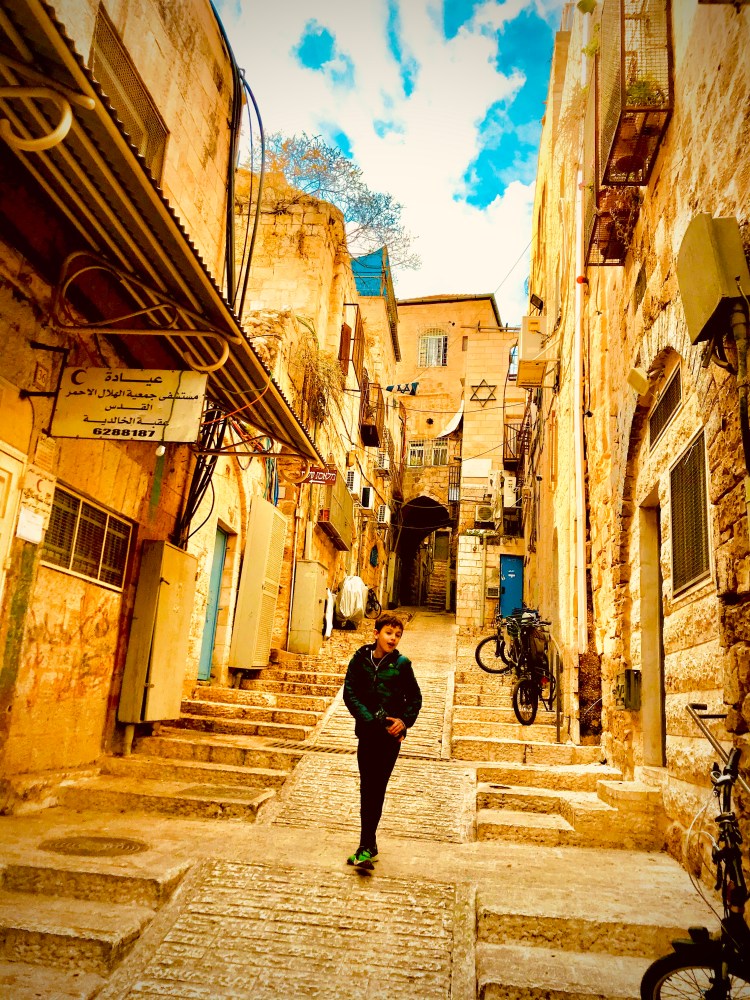
As we entered the Old City, which was our focus for the day, we immediately encountered vendors selling their offerings from drinks (freshly pressed pomegranate juice was common), spices, and religious items, to t-shirts and candy. We had encountered the Arabic Market.
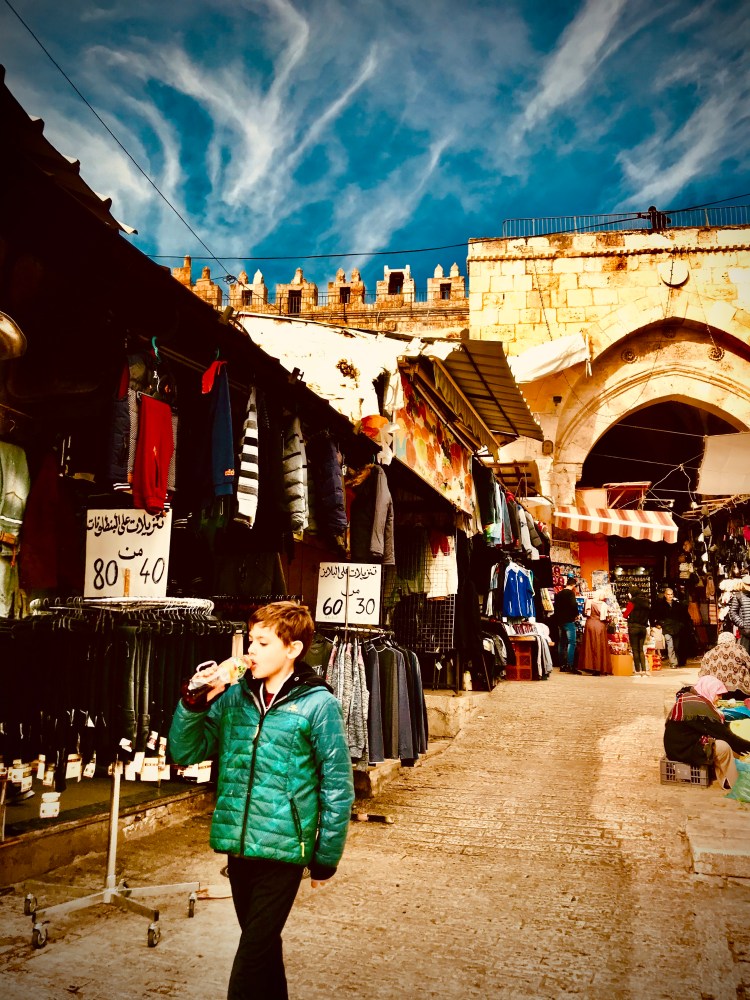
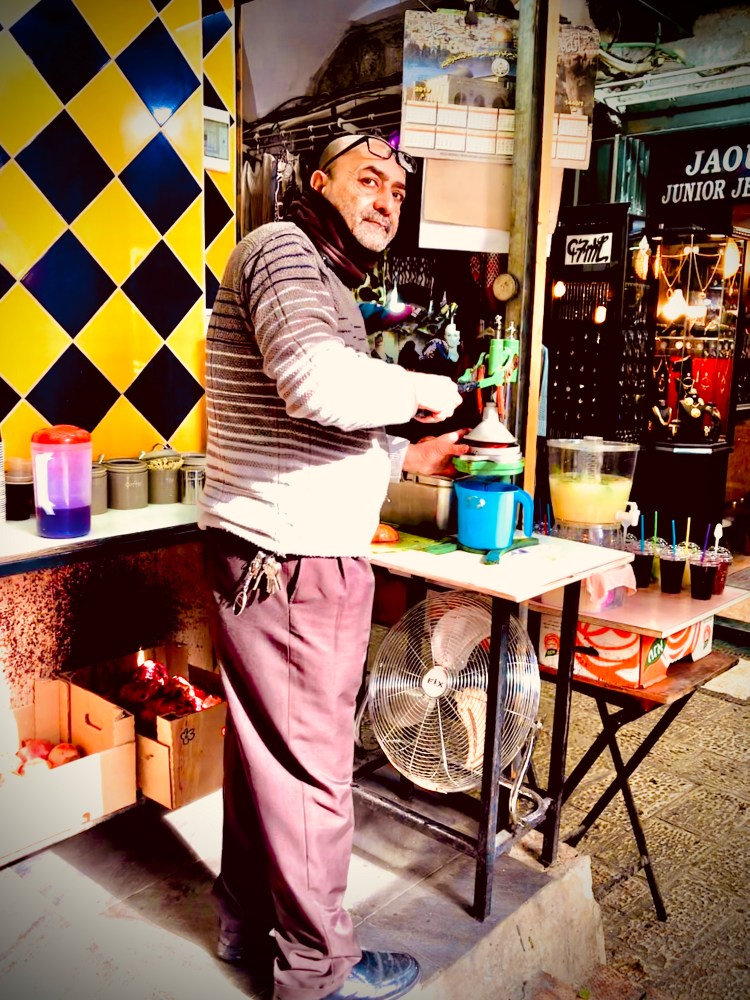
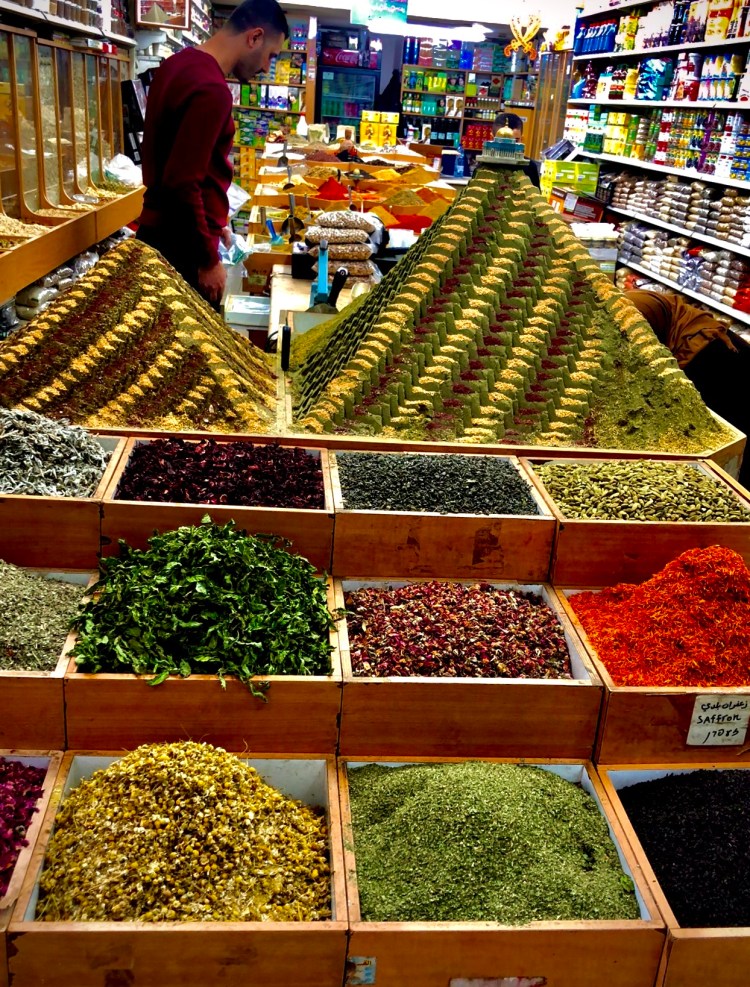
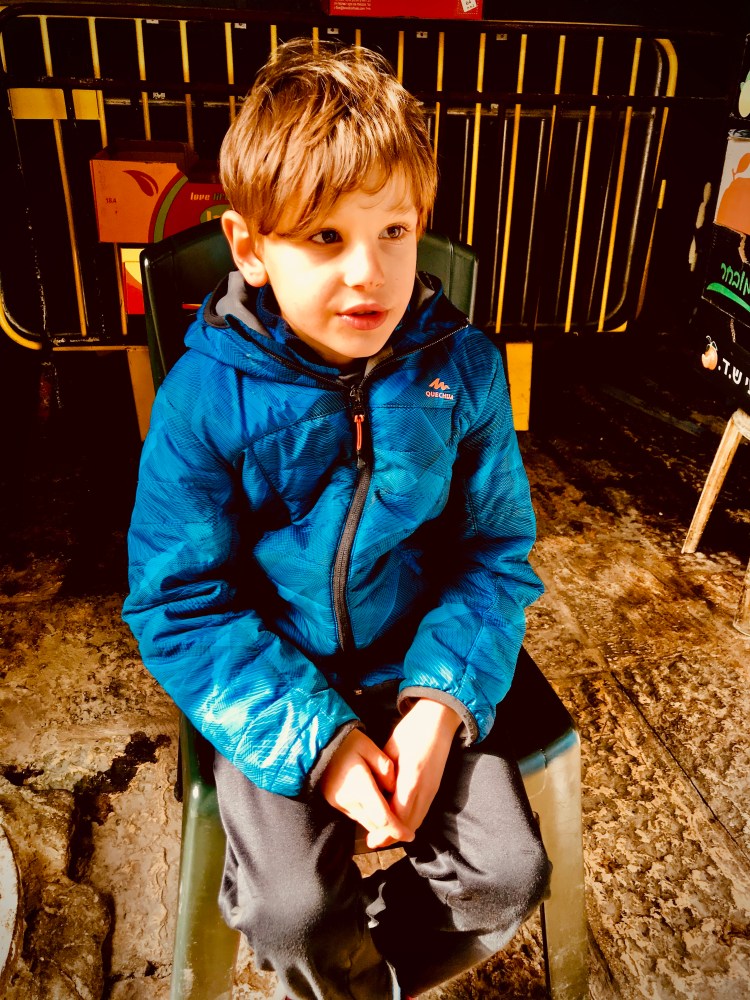 {Jerusalem Old City}
Isaac was quite tired and continued on Dave’s back, while Ben and I followed a few paces back.
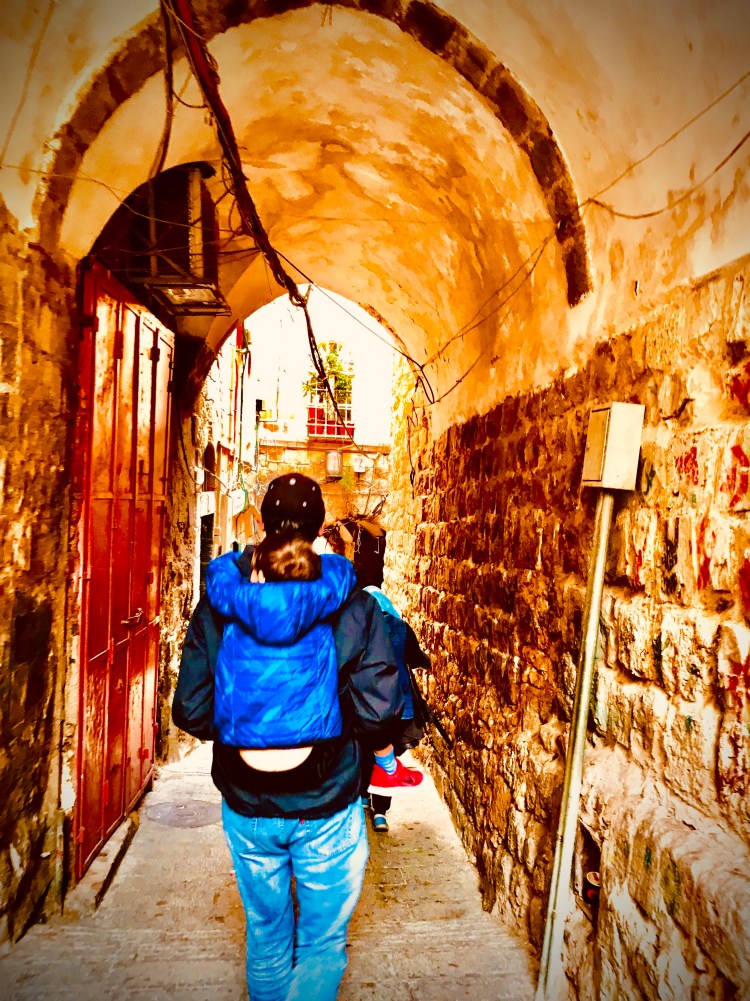

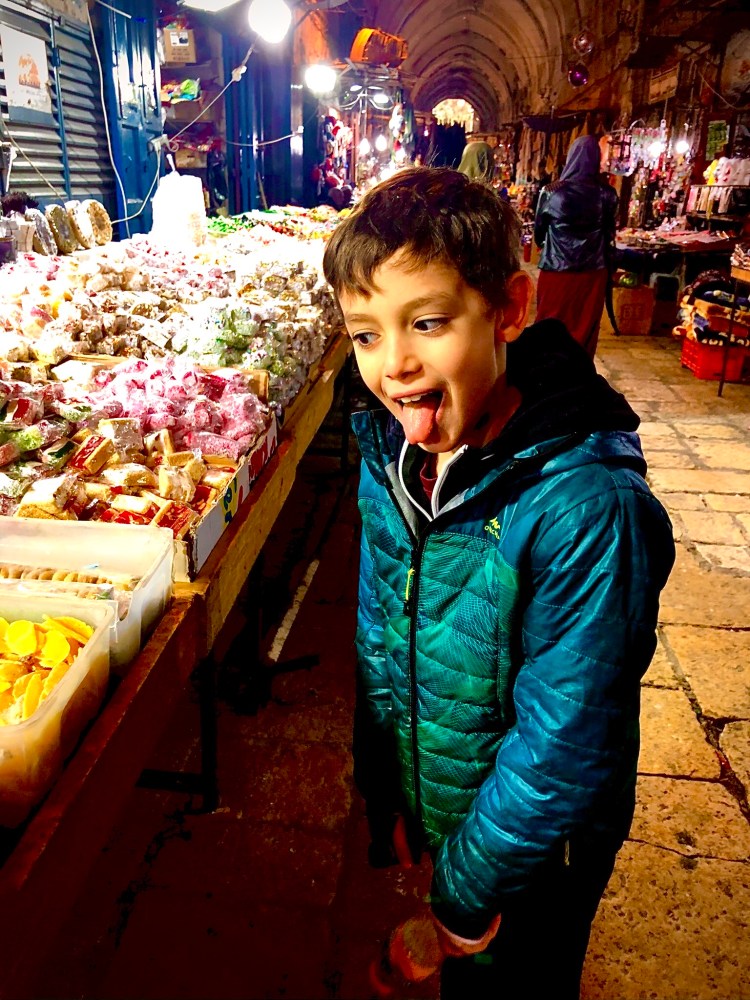
 {Discovering Old City of Jerusalem}
Our first destination was the Western Wall. We continued down one lane to only be met with security with machine guns over their shoulders. They told us that we could go no further. We apparently had reached an entrance to the Temple Mount in the Muslim quarter. I was surprised as I had not expected to be asked to turn around because this area was off-limits. We had unknowingly arrived during the time access was closed.
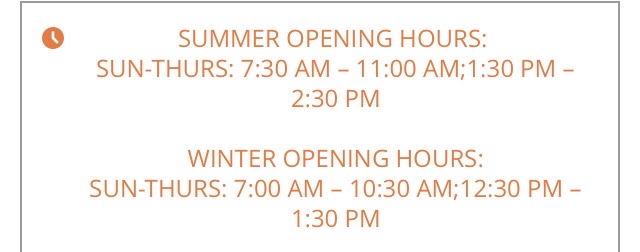 {Temple Mount visiting hours}
I later learned that non-Muslim visiting hours are limited and that the Temple Mount must be entered through security via one entrance that was nearer to the Western Wall.
https://www.earthtrekkers.com/how-to-visit-temple-mount-dome-of-the-rock/
{Click link for historical background and visiting guidelines}
So we reversed our direction and tried another passageway, which led us to the security check before entering the Jewish area at the Western Wall.
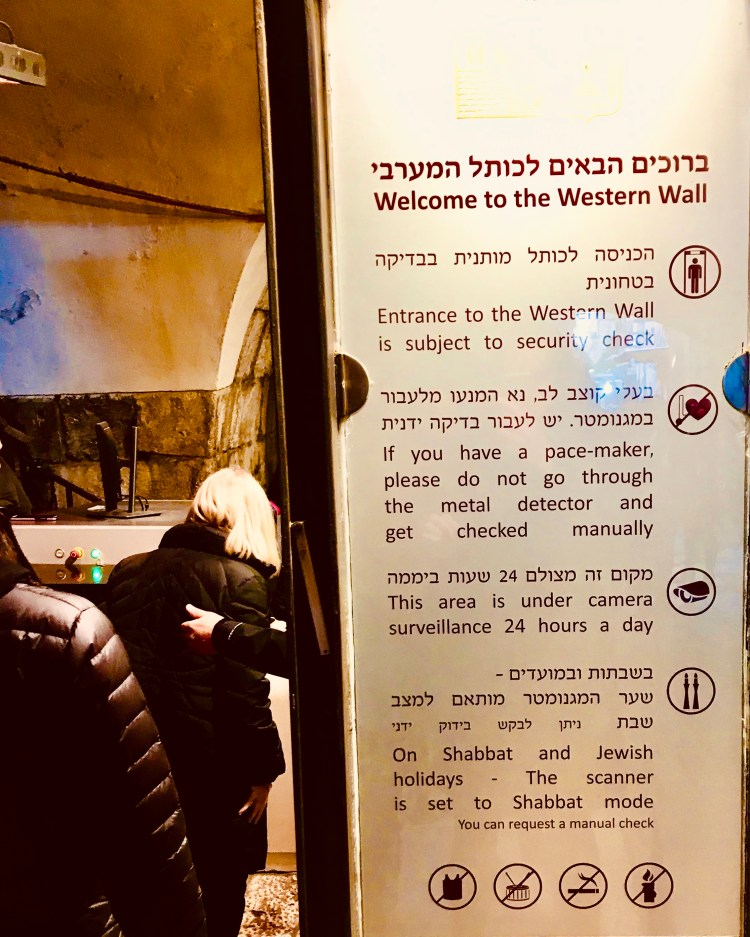
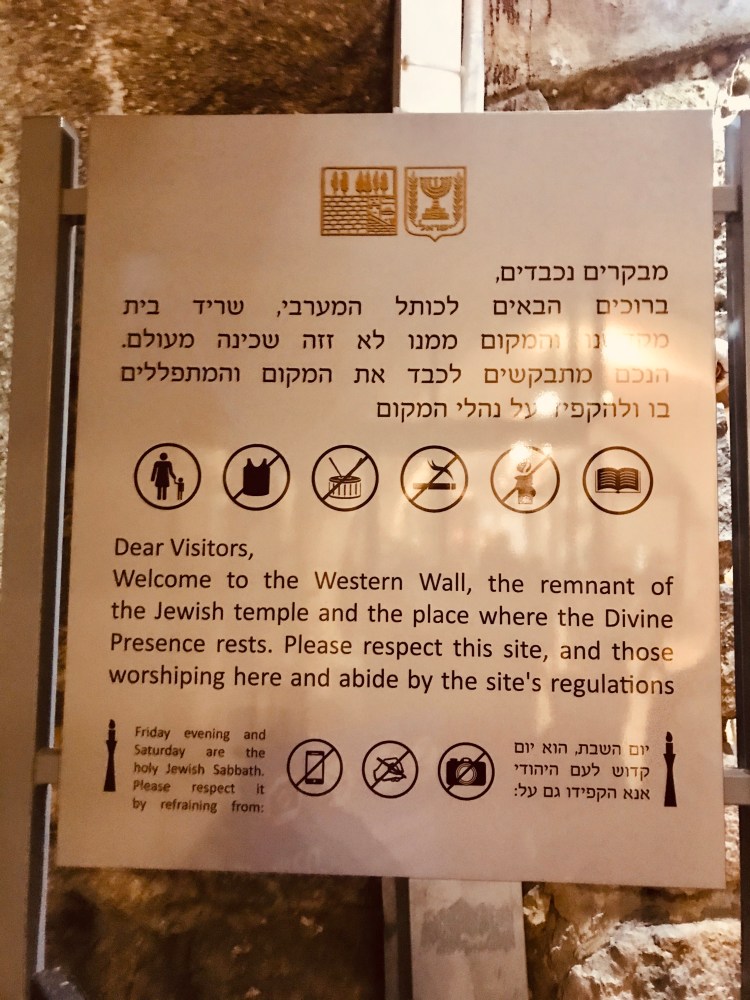 {Security at the Western Wall}
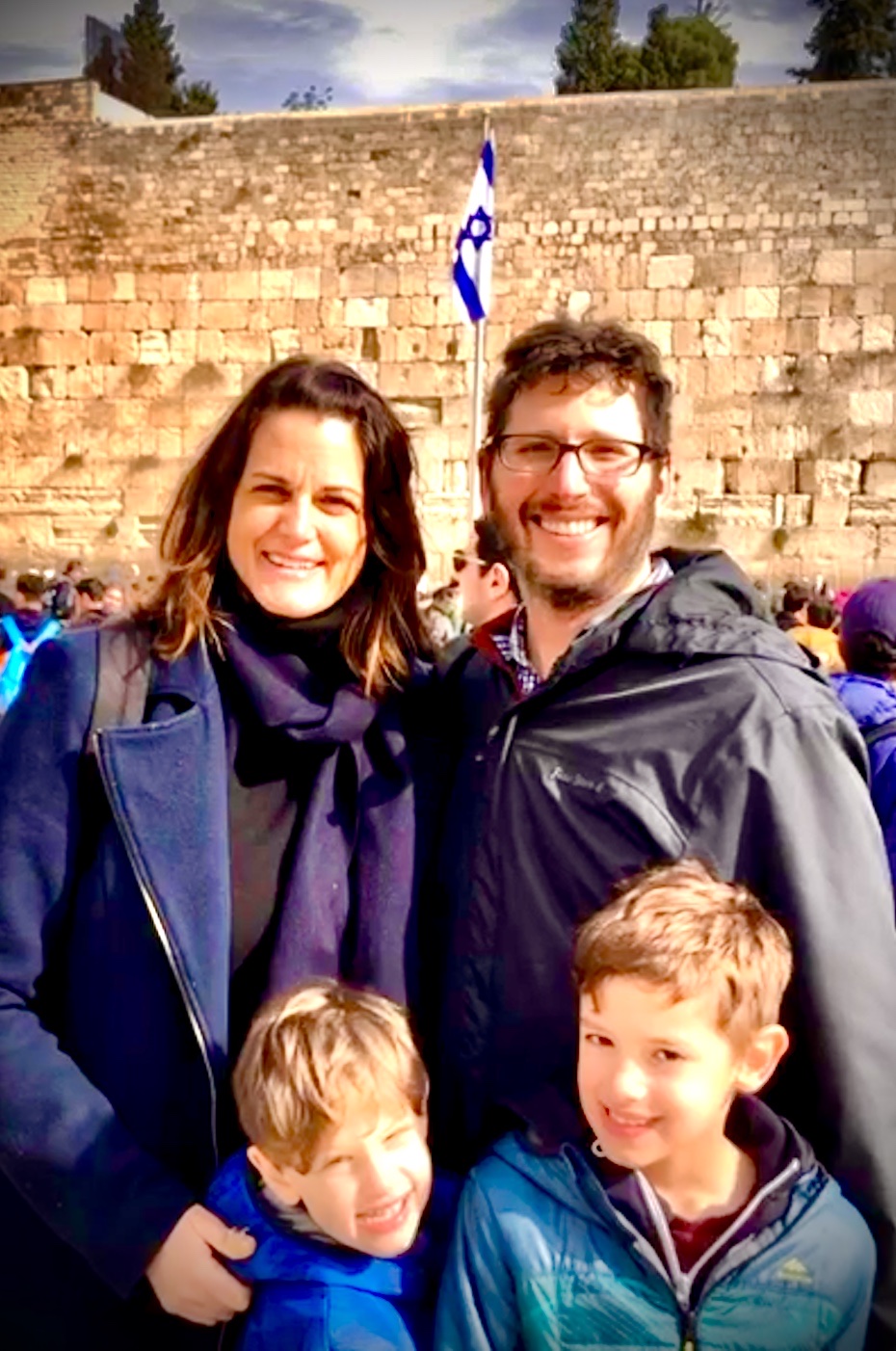
To go to the Wall, I had to leave Dave and the boys as females and males had separate areas. I actually welcomed the chance for uninterrupted reflection as I wrote my prayers on a sheet of paper to leave in a crack of the wall.
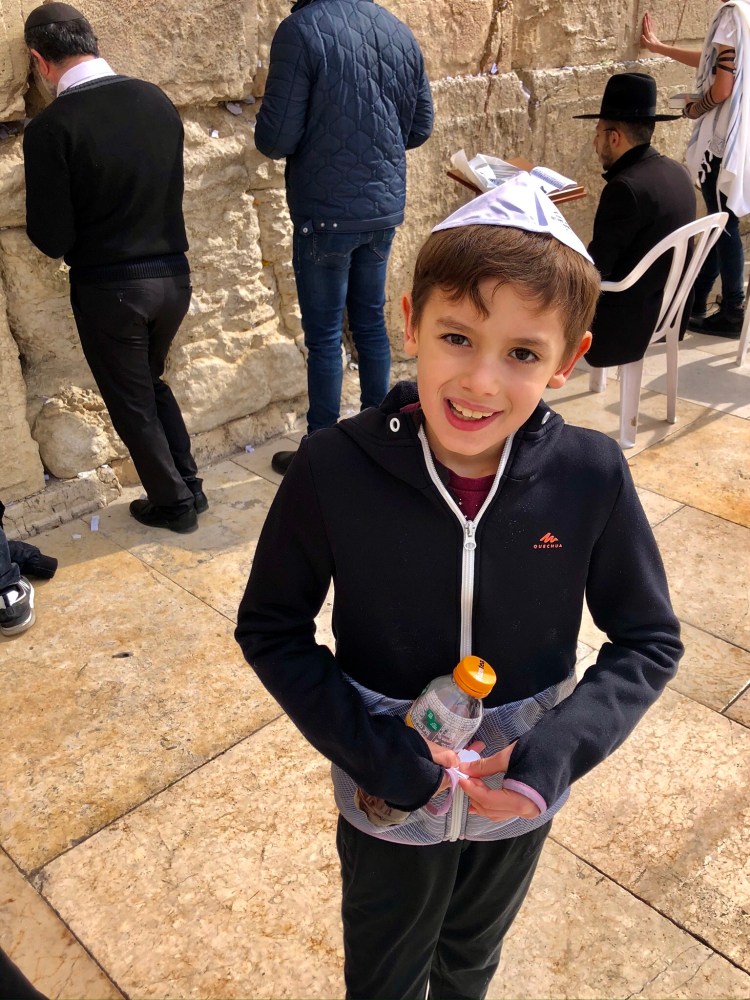
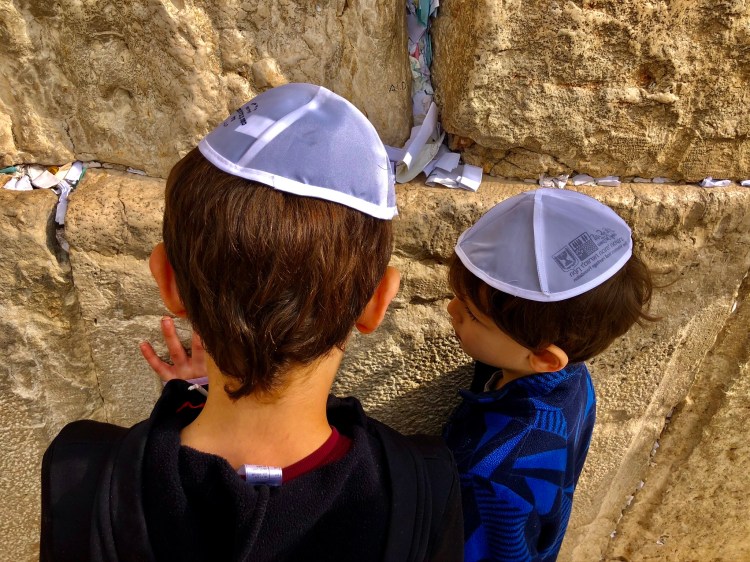
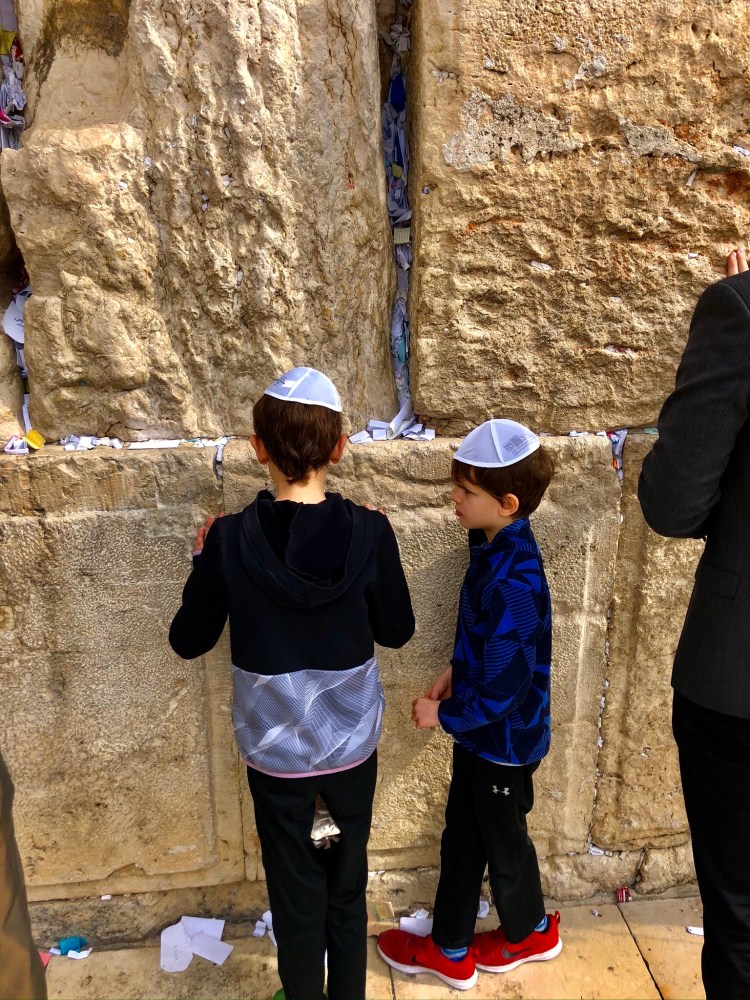

 {At the Western Wall}
After meeting back up, the boys told me that they had written “selfless” prayers as well as a personal prayer on their papers. (Of course, Dave wrote Isaac’s for him.) It was very touching to see them think about the world at large while delighting in personal wishes.
Being lunchtime, our stomachs willed us to find some food. So we left the Western Wall security area and ascended a staircase within the Jewish Quarter. I had no idea of what to expect for lunch options as my whole experience in the Old City had been so surreal up until this point.
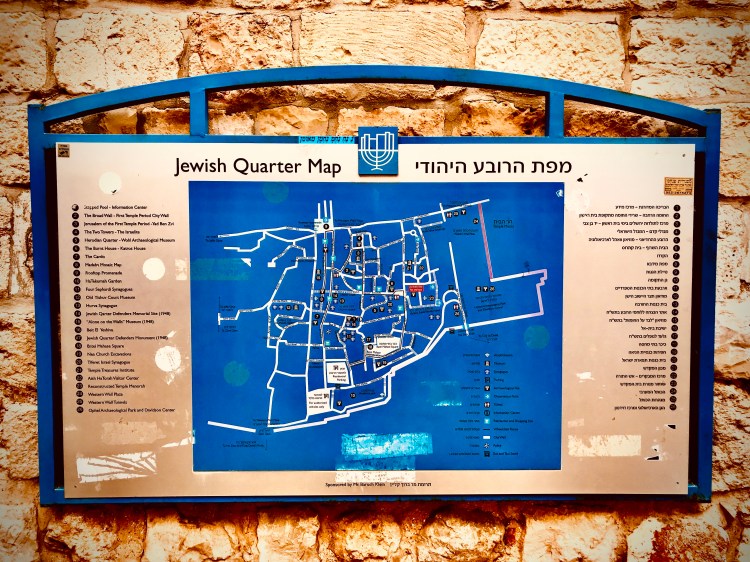
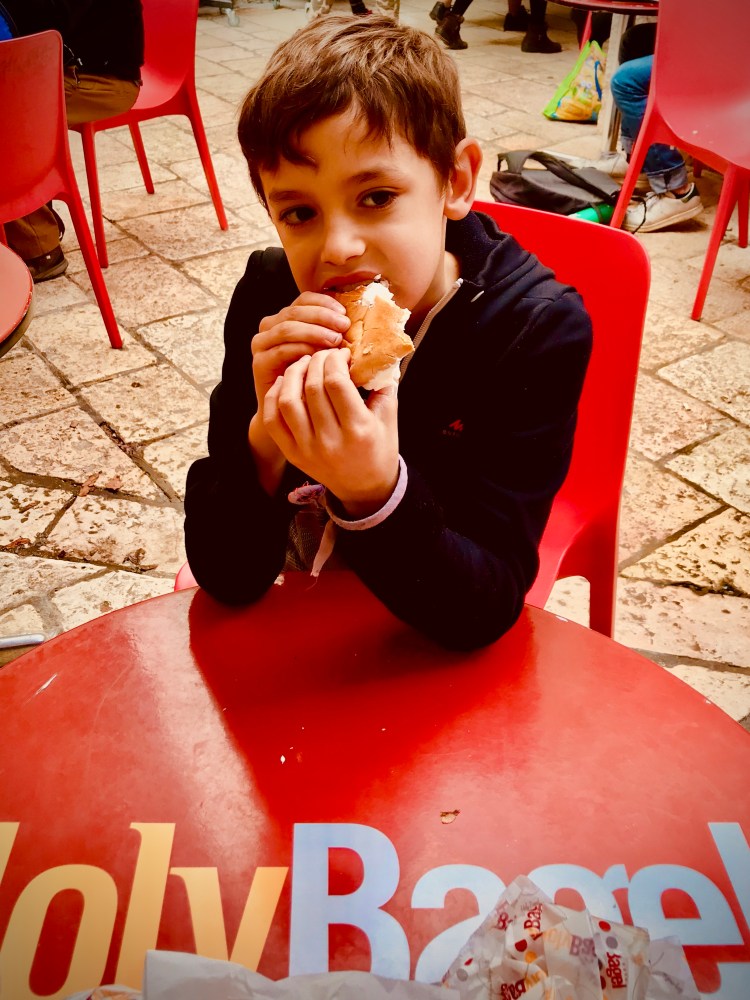 {Holy Bagel lunch break in Jerusalem}
We quickly came upon a courtyard with various cafes. Ben and I chose bagels and soup from Holy Bagel, while Dave and Isaac enjoyed burgers and fries.
By this point, the boys were getting tired and were losing interest. So Dave offered to take them back to Tel Aviv alone, so I could still spend the rest of the afternoon in the Old City. (It was a very nice thing for him to do. He had already been to Jerusalem twice and generously gave me time alone to explore the city.)
So I walked around until I came across a visitor center where I could hop onto the WiFi and pick up a physical map (I had not signed up for cell service while in Israel and relied on WiFi during the trip).
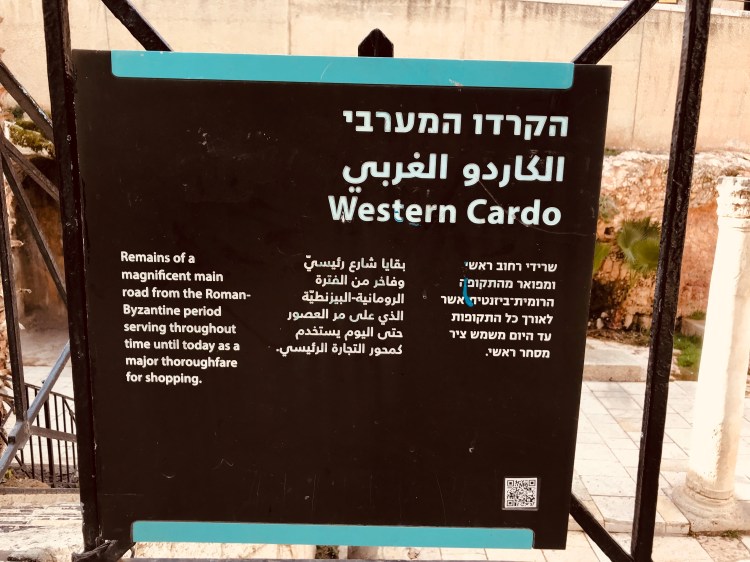
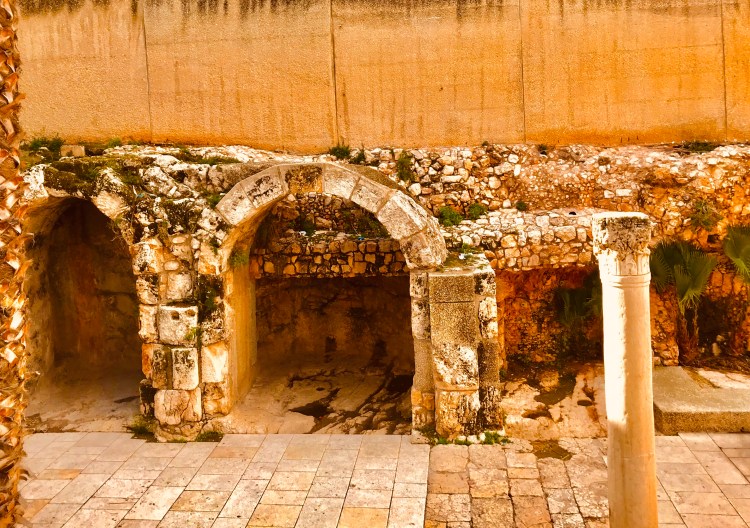
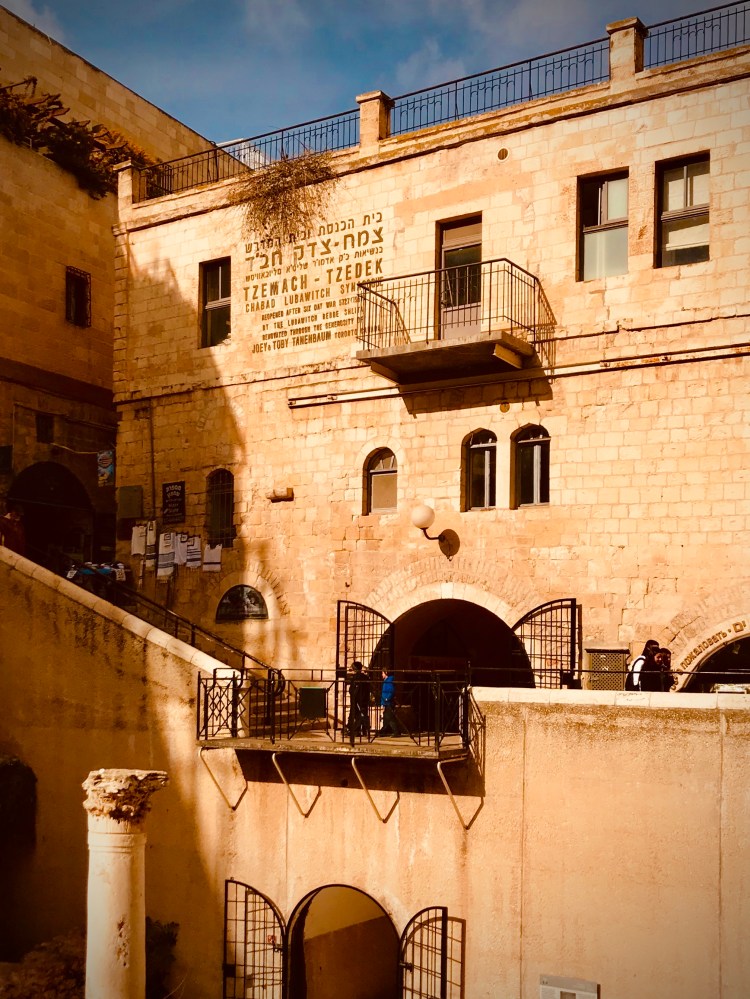
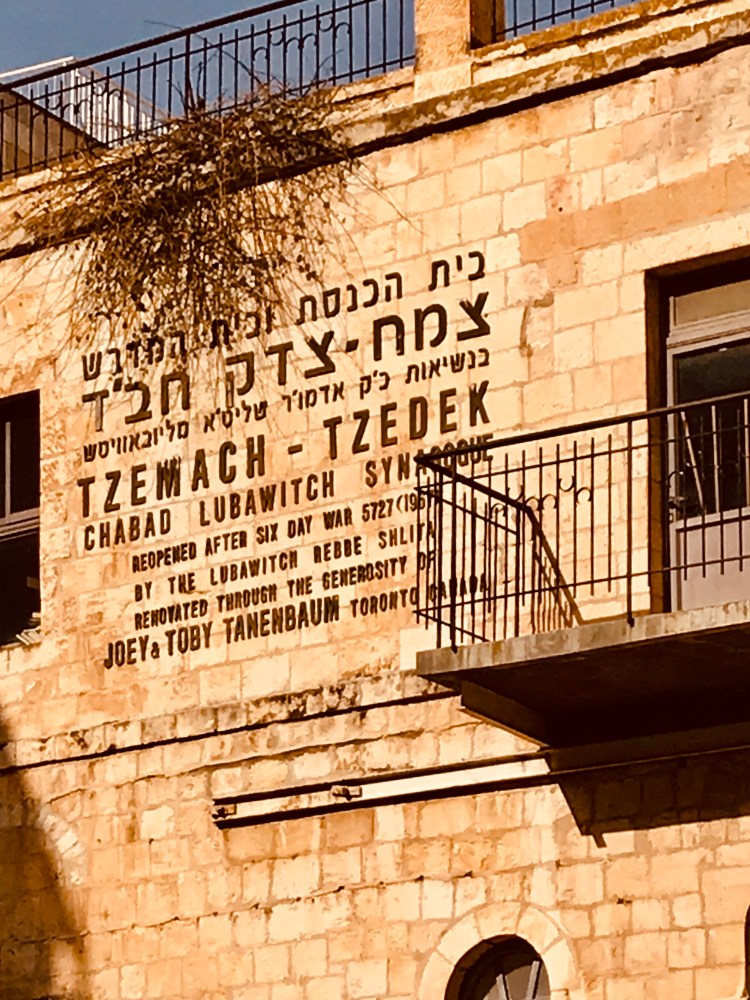
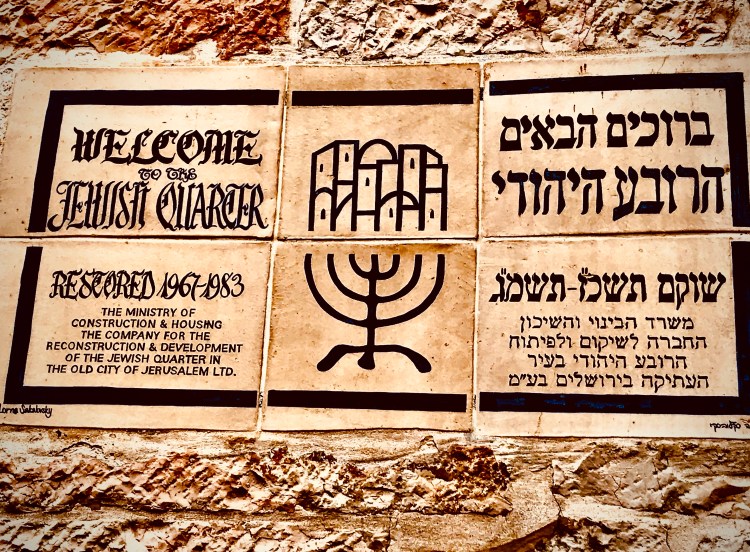
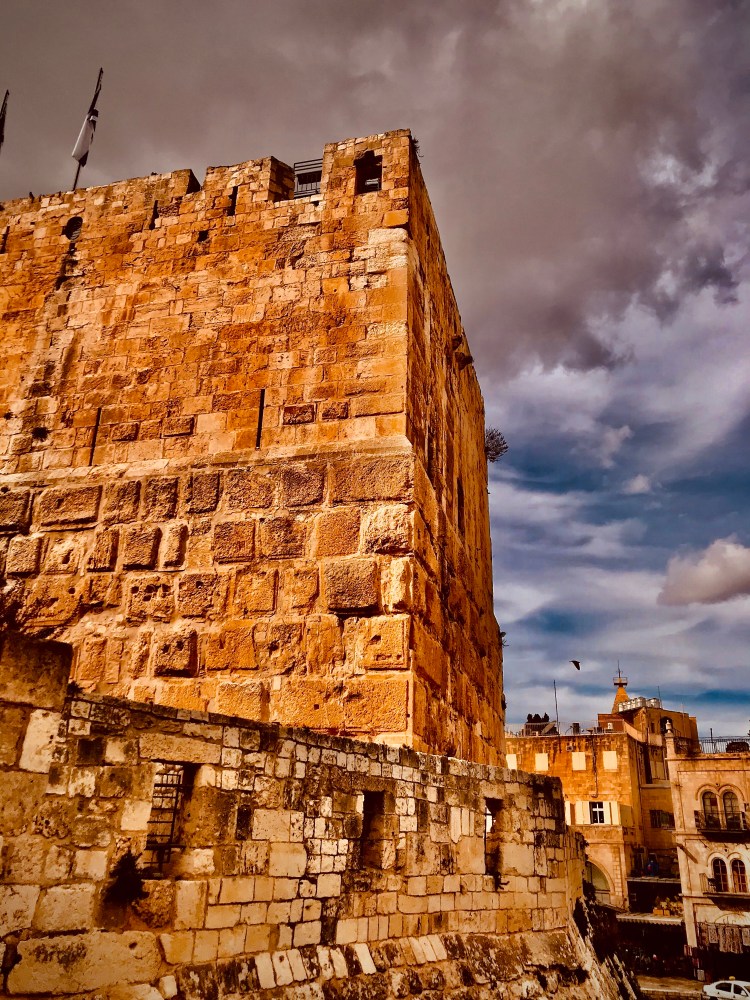
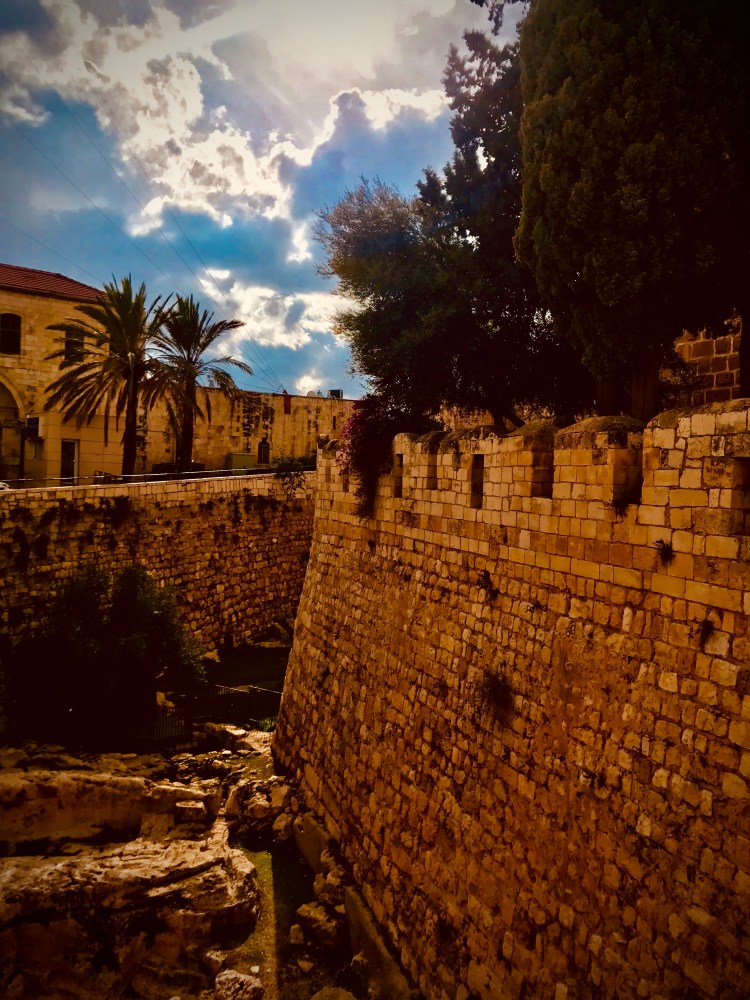 {Tower of David}
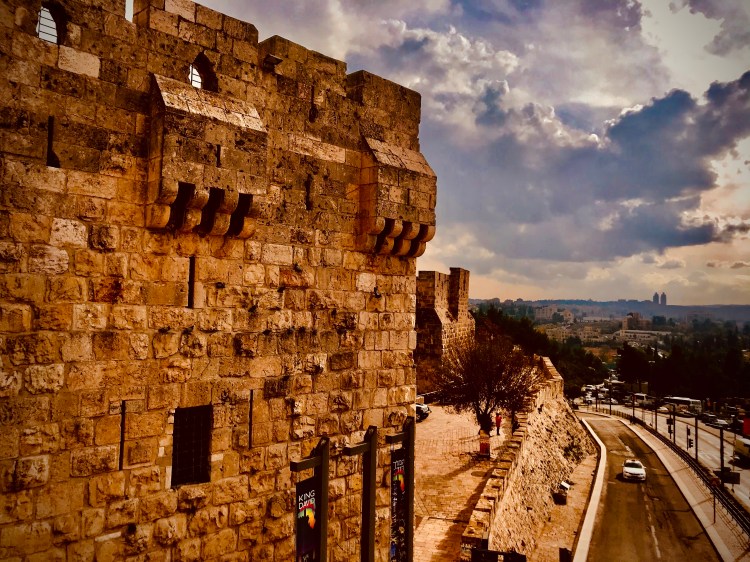 {Jaffa Gate}
While at the visitors center, I learned I could walk along the ramparts (City Wall walkway) to take in the city from above. This was something I was very interested in doing and was appreciative that I didn’t have the boys with me to slow me down.
There were two routes that I could take, the Northern Route and the Southern Route. I chose the former.
The walk began at the Jaffa Gate, which is part of Suleiman’s wall from the sixteenth century. It is named after the city of Jaffa to the west, the destination of the road that begins there. The Arab name of the gate is Bab el-Halil. In 1898 a breach was opened in the wall near the gate and the moat at its foot was filled with earth to allow the grand entry to the city of the German Emperor Wilhelm II and his wife Augusta Victoria and their entourage.
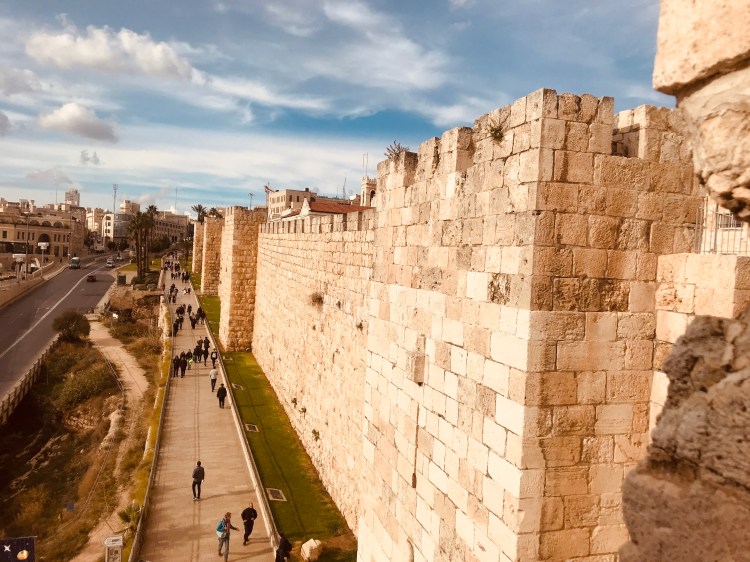
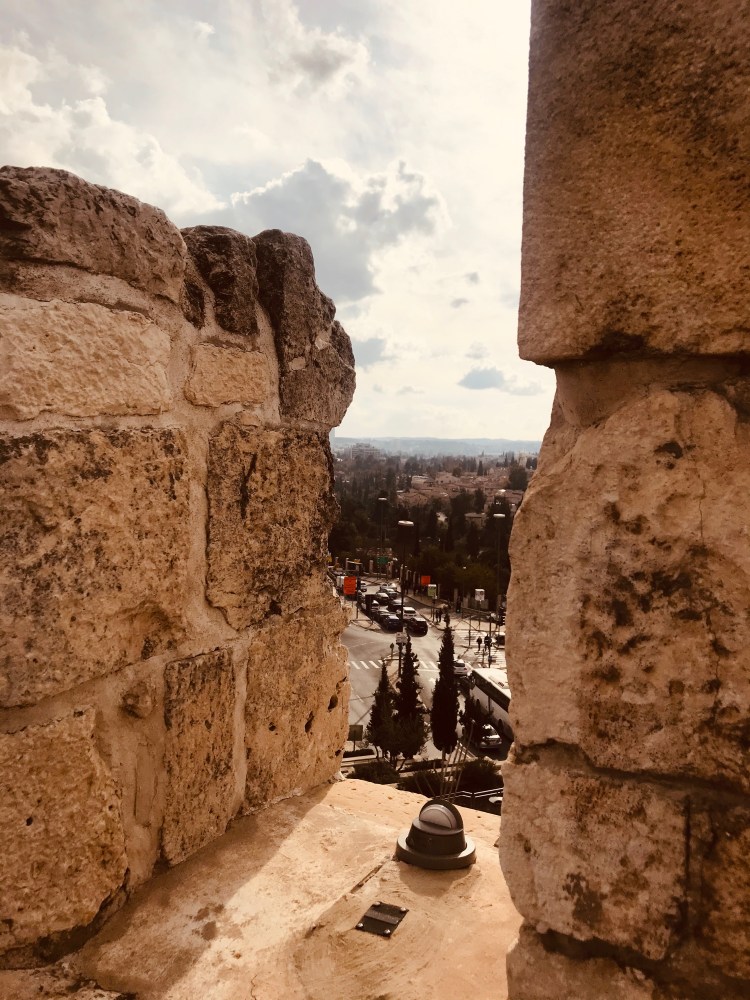

 {The Christian Quarter and the New City}
The building and the tower flying the Vatican flag belong to the Catholic Patriarchate in Jerusalem, which was founded in the mid-nineteenth century after many years during which the Catholics of the country were represented by the Franciscan order. The building is located in the Christian Quarter, one of the four quarters of the Old City in the heart of which stands the Church of the Holy Sepulchre. Looking beyond the walls, one can see the neighborhood of David’s Village.
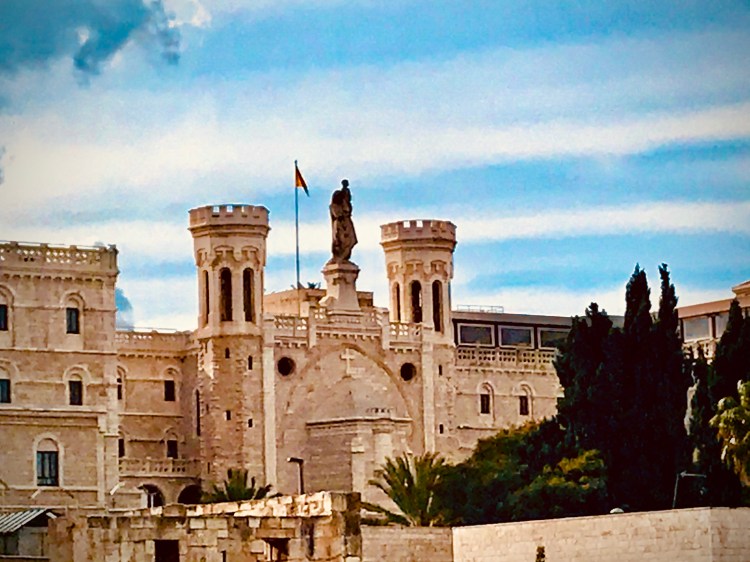 {Flying the flag of the Vatican}
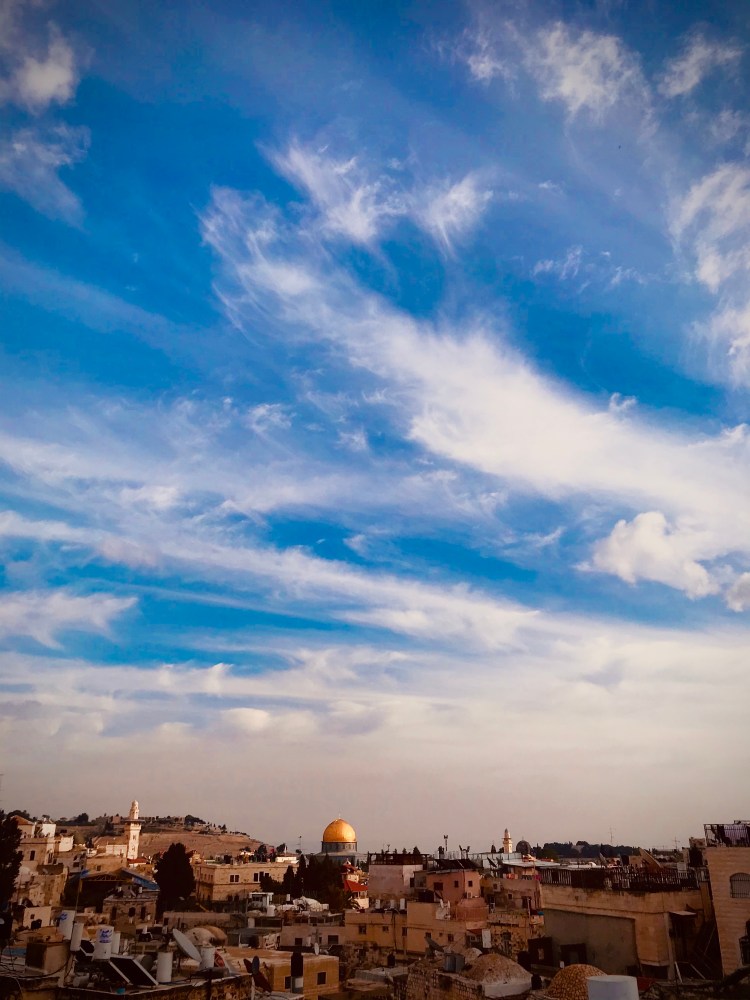 {Iconic Golden Dome in the background}
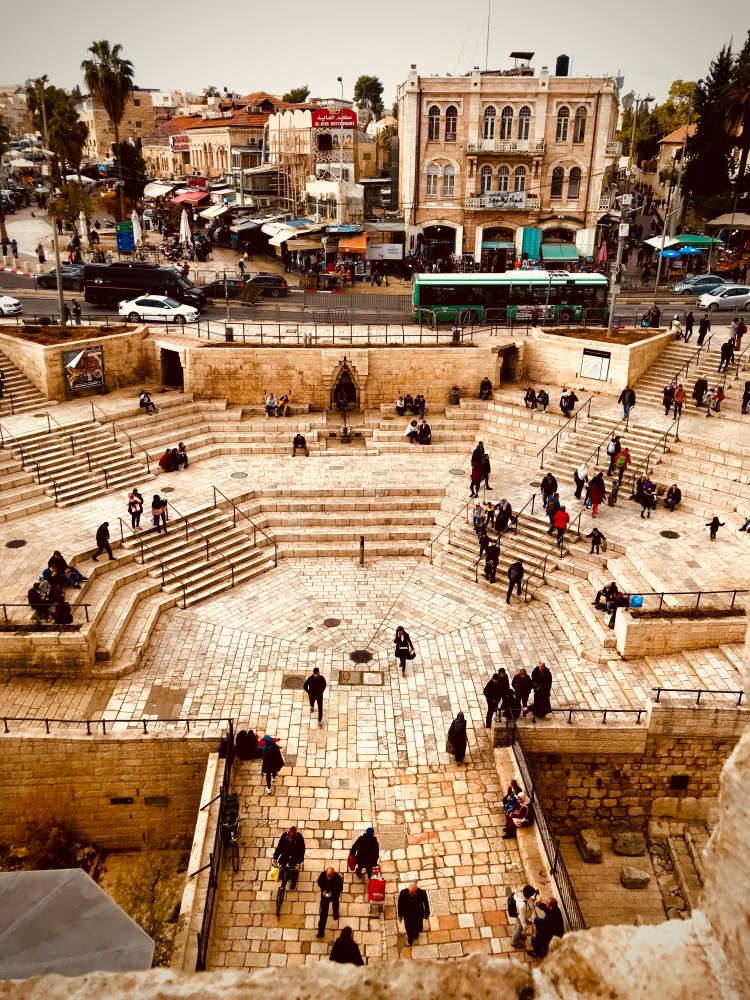 {Damascus Gate, where we first entered the Old City, as seen from above}
At the foot of the Damascus Gate are the remains of a gate and plaza dating from the Roman period. The view at the gate from the ramparts over the Old City reflects Jerusalem as a city sacred to Judaism, Christianity, and Islam. Across is the Dome of the Rock on the Temple Mount, the location of the First Temple and the Second Temple. In the Christian Quarter, one can see the two domes of the Church of the Holy Sepulchre and in the Jewish Quarter, the dome of the Hurva Synagogue.
(Video of Jerusalem from the Ramparts during the call to prayer)
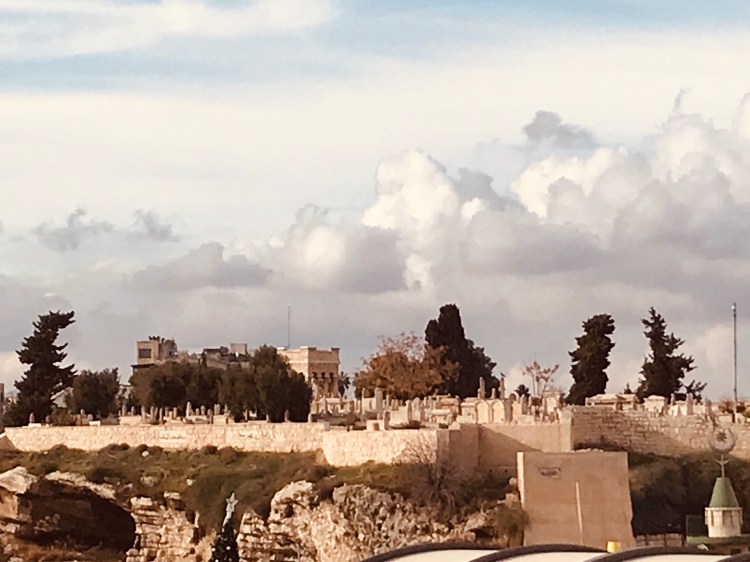 {View of a Muslim Cemetary outside the wall}
At this point, I was standing near the Muslim Quarter inside the wall. This is the largest quarter in the Old City, home to Jews, Christians, and Muslims. Outside the wall, is a cliff with large caves, on top of which is a Muslim cemetery. Since the late nineteenth century, Anglicans and other Protestants have regarded this site as the place where Jesus was crucified, buried and resurrected. The site contains a tomb from the First Temple period.
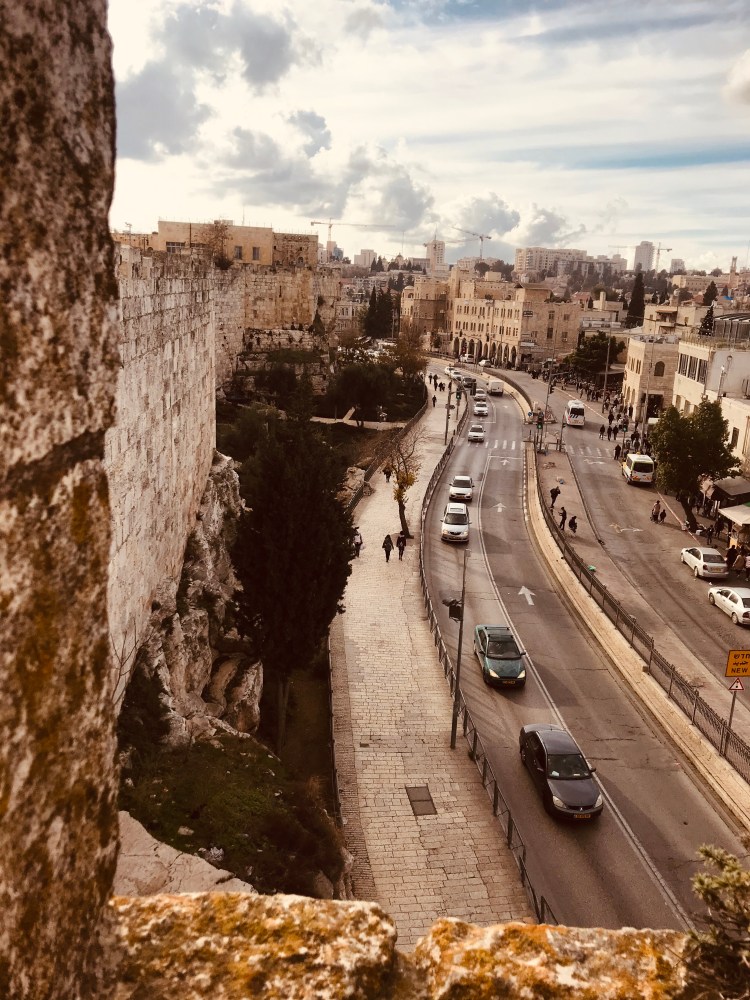 {View of Street from the Old Wall Ramparts}
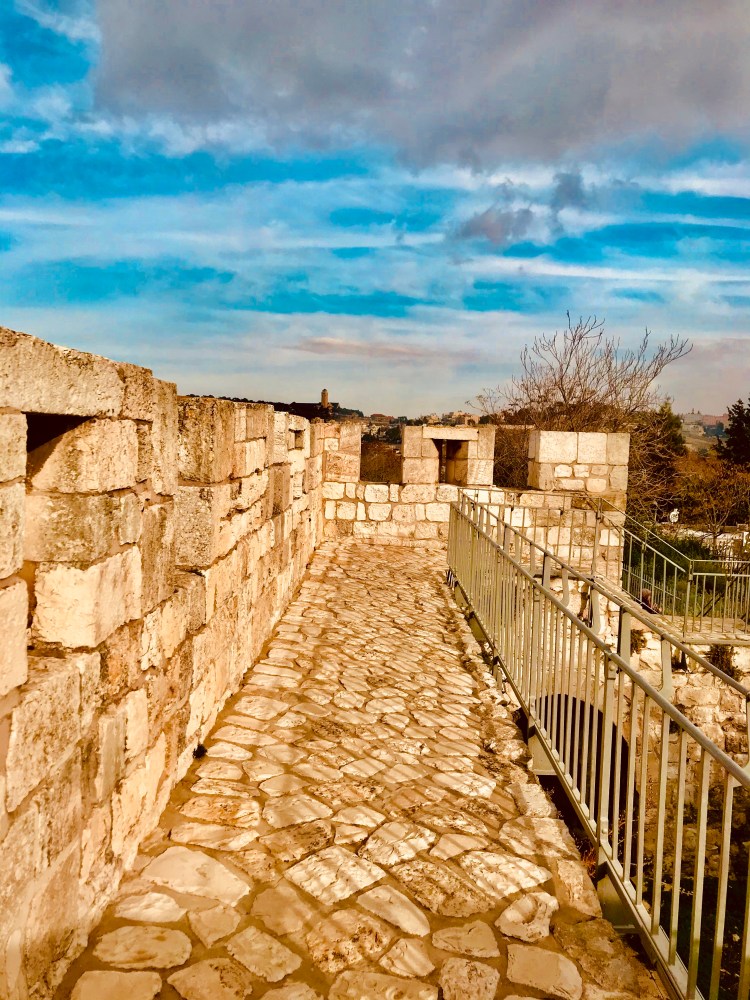 {View of the Old Wall Ramparts}
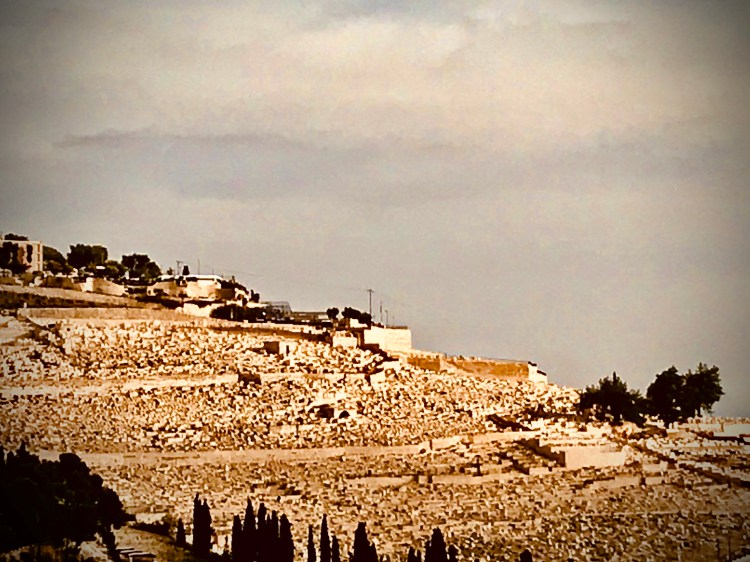 {The Mount of Olives}
Beyond the walls, is the Mount of Olives, which Jewish tradition associates with the End of Days and the resurrection of the dead. In Christian tradition, the mount is famed as the backdrop for the events of the last week in Jesus’ life. According to Muslim tradition, in the End of Days, a bridge will stretch between the Mount of Olives and the Temple Mount and the resurrected will walk across it to eternal life. The Jewish cemetery on the Mount of Olives is the most ancient and important Jewish burial ground in the world.
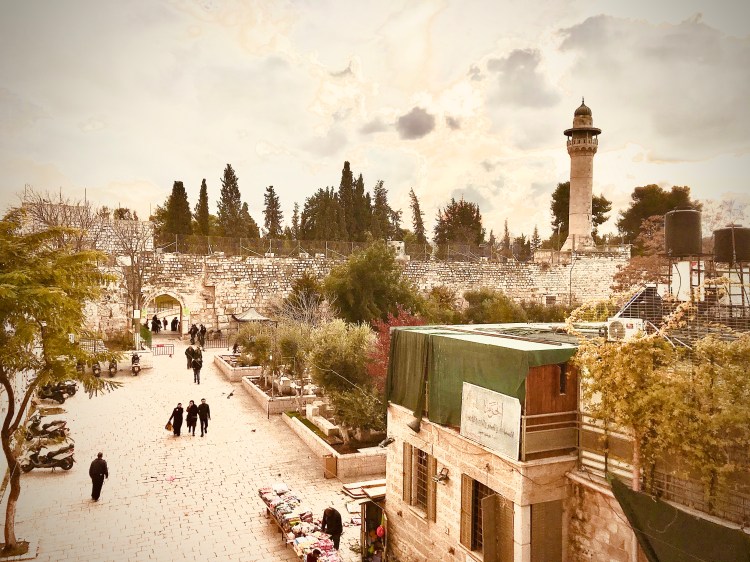 {View into the Temple Mount area}
At this point, I had spent an hour on the Ramparts, being led down before reaching the Temple Mount in the Muslim section. This was a section that I would not be permitted to visit at this time. So I got out my visitor’s map and realized I was near the beginning of the The Way of the Cross (a religious path following Jesus’ Passion) also known as Via Dolorosa.
 {Alleged place of Mary’s birth}
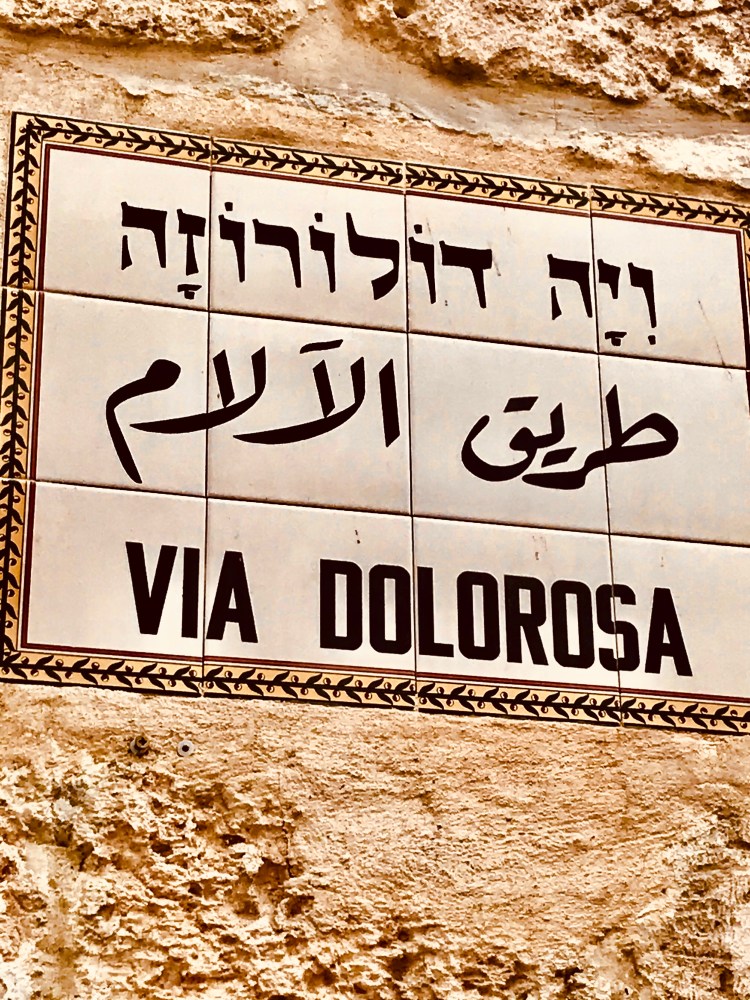
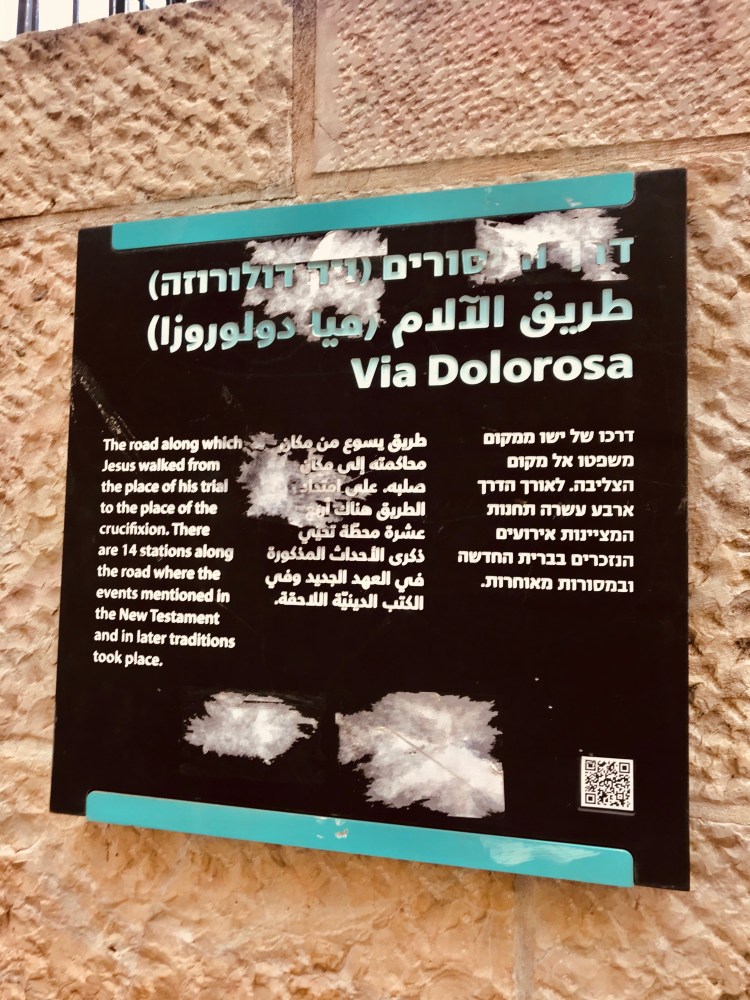 {Via Dolorosa – The road along which Jesus walked from the place of his trial to the place of his crucifixion}
Below are pictures of many of the Stations along the road where the events mentioned in the New Testament and in later traditions took place, as well as a map and explanation of the path.

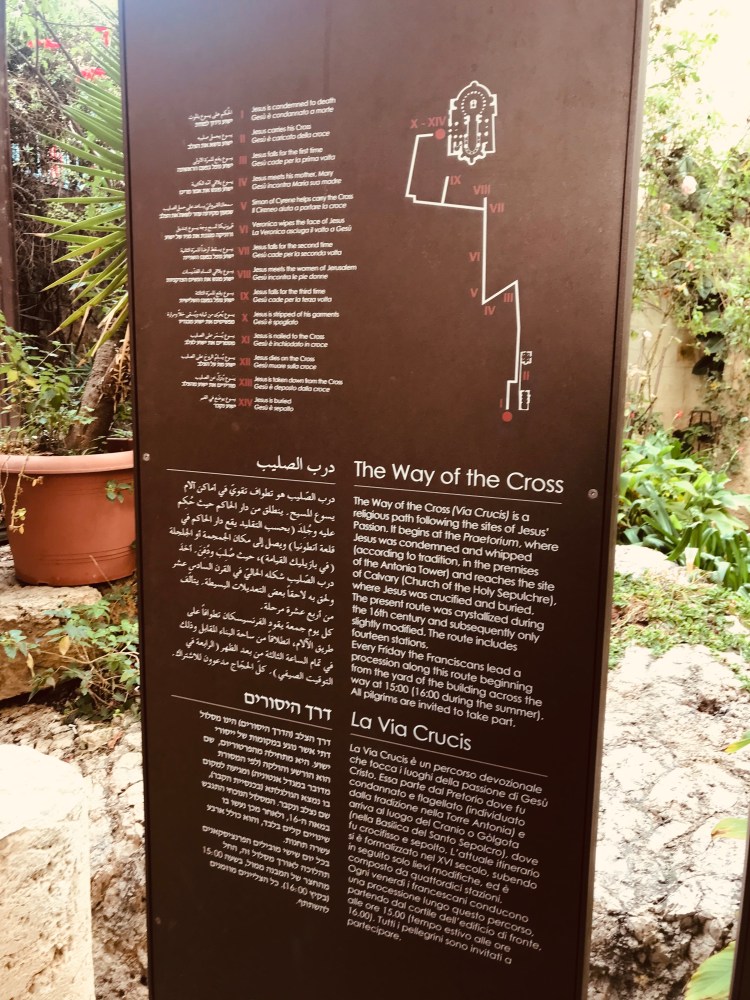

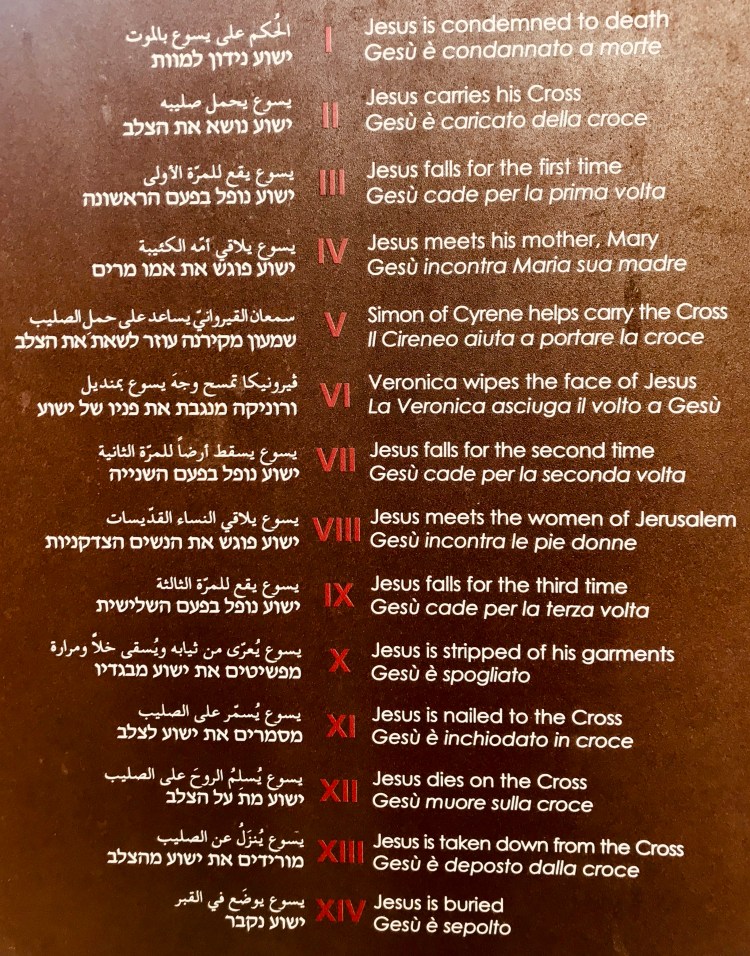 {Explanation of each station}
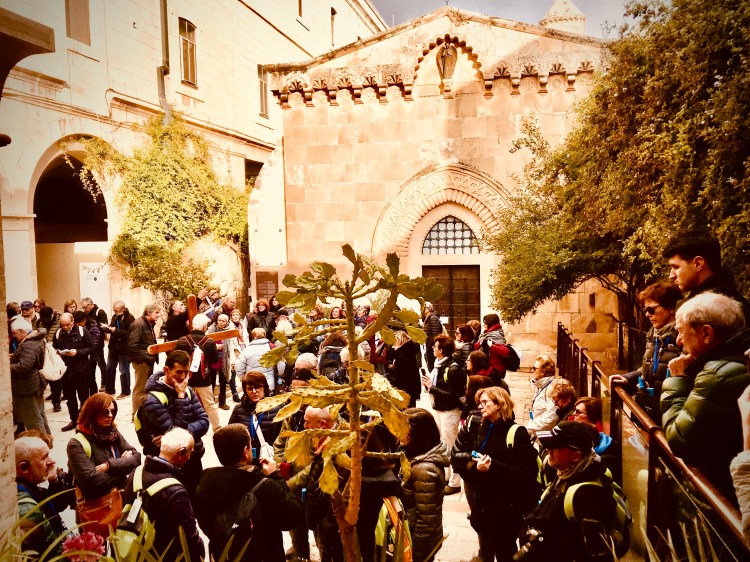

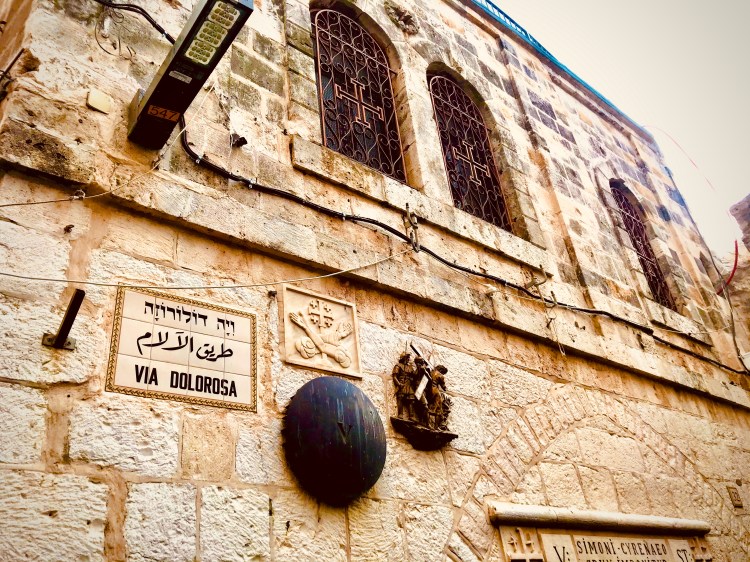
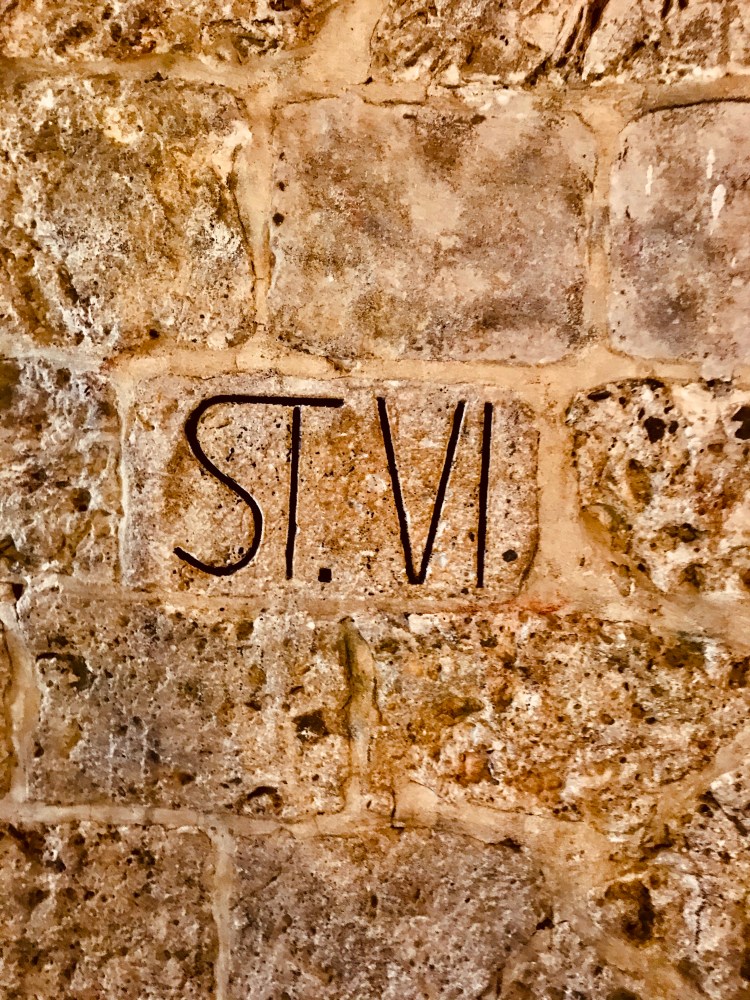
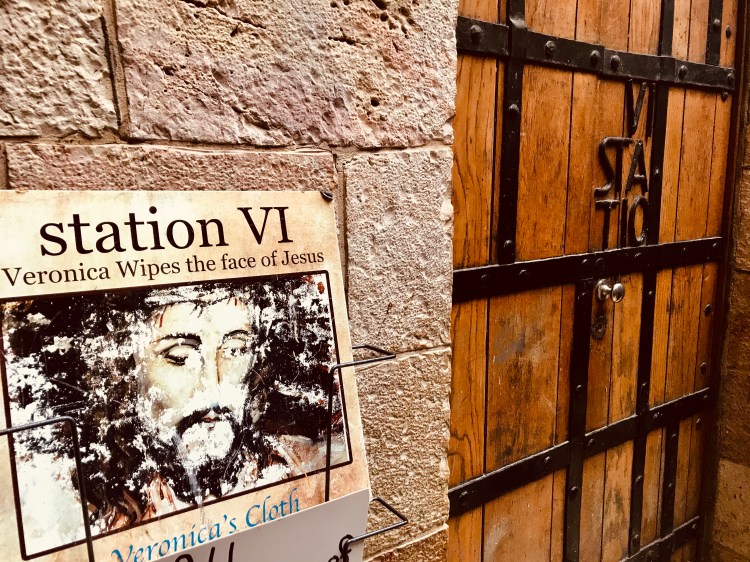
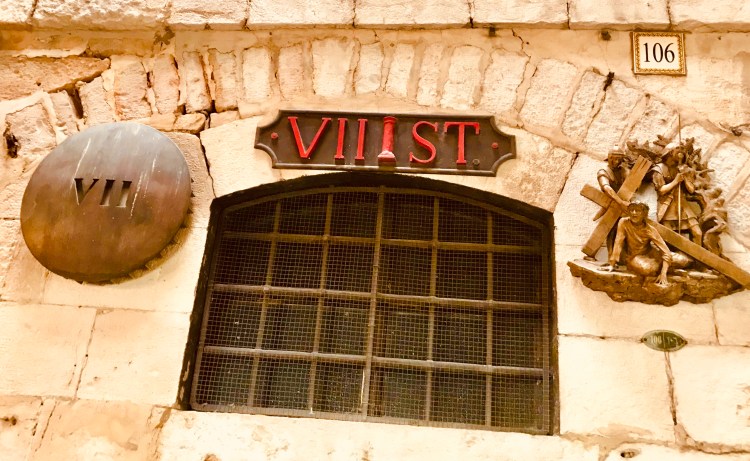
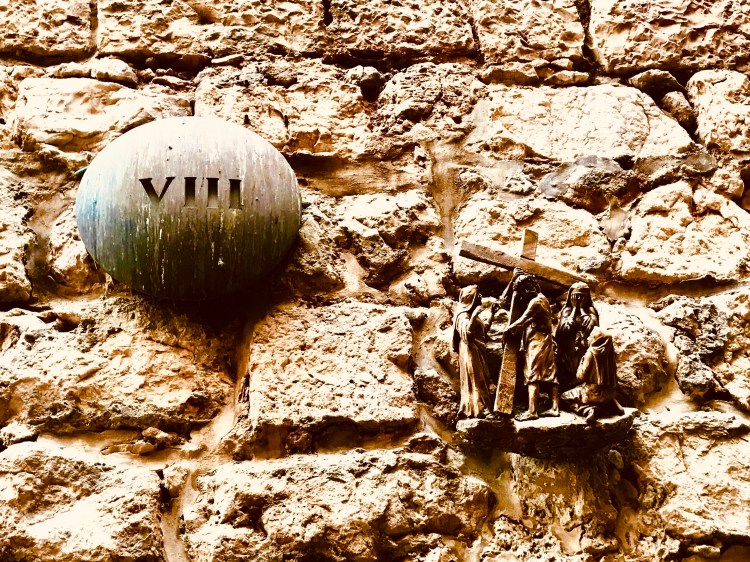
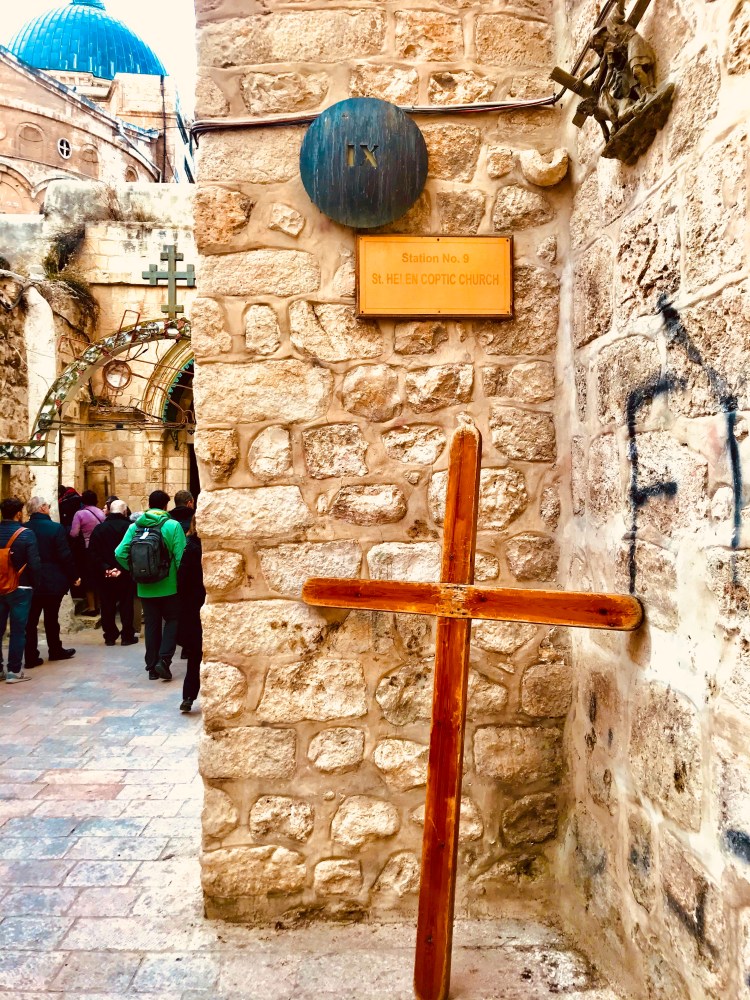
{Worshipers chanting as they walk the path}
I continued on until I reached the Church of the Holy Sepulchre, which was consecrated in the year 335. The church was the end of the path, as this was the site of Jesus’ crucifixion, burial and resurrection.
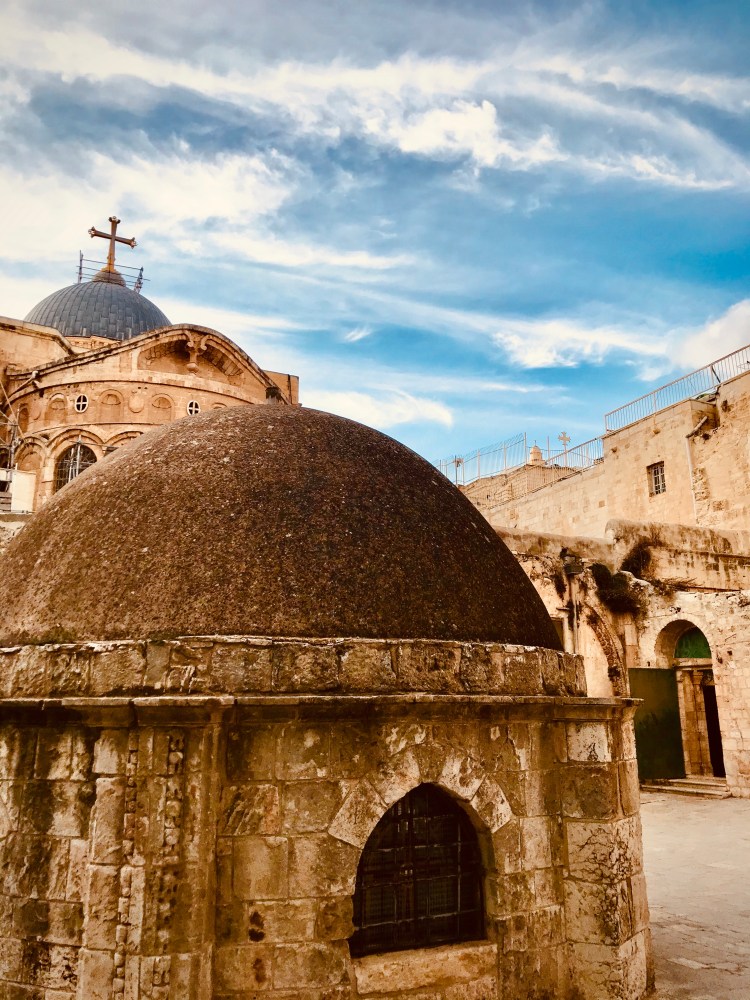
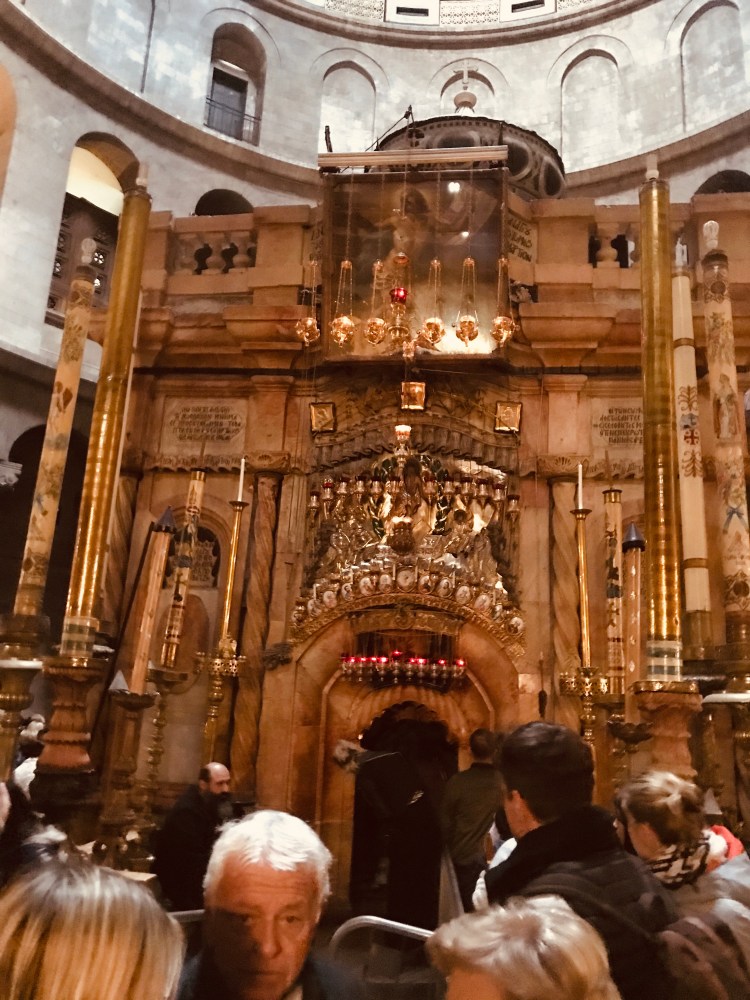
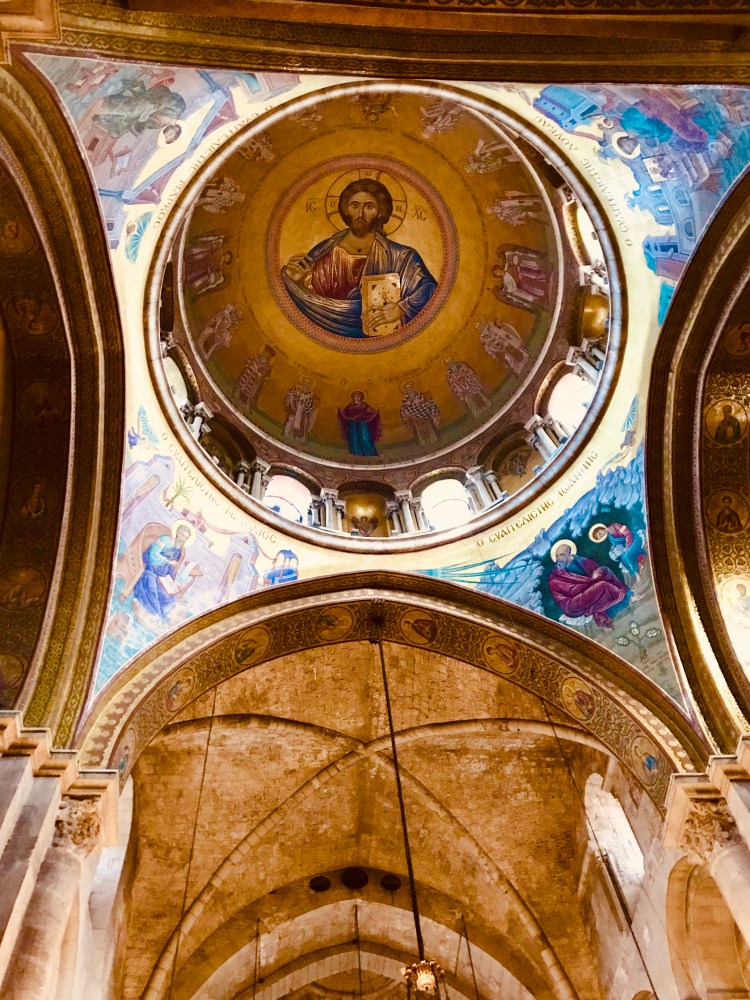 {Church of the Holy Sepulcher, site of the crucifixion, burial and resurrection of Jesus of Nazrene}
There was a very long, slow-moving line to enter the area where the tomb where Jesus was buried and resurrected lay. I skipped the line and viewing as I was feeling quite overwhelmed. This church, with its very strong incense, crowds, low lighting, various chapels, low ceilings, and many corridors was too much for me. It was crowded, dark and confusing. But also powerful, poignant and awe-inspiring. Afterward, I realized the tour would have been better served with a guide.
Emerging back to the street, I decided to head back to Tel Aviv. But before getting out of the Old City Walls, I came across what was probably the most unexpected kiosk of the day. As I took this photo, a man yelled “Roll Tide” and I just had to laugh.
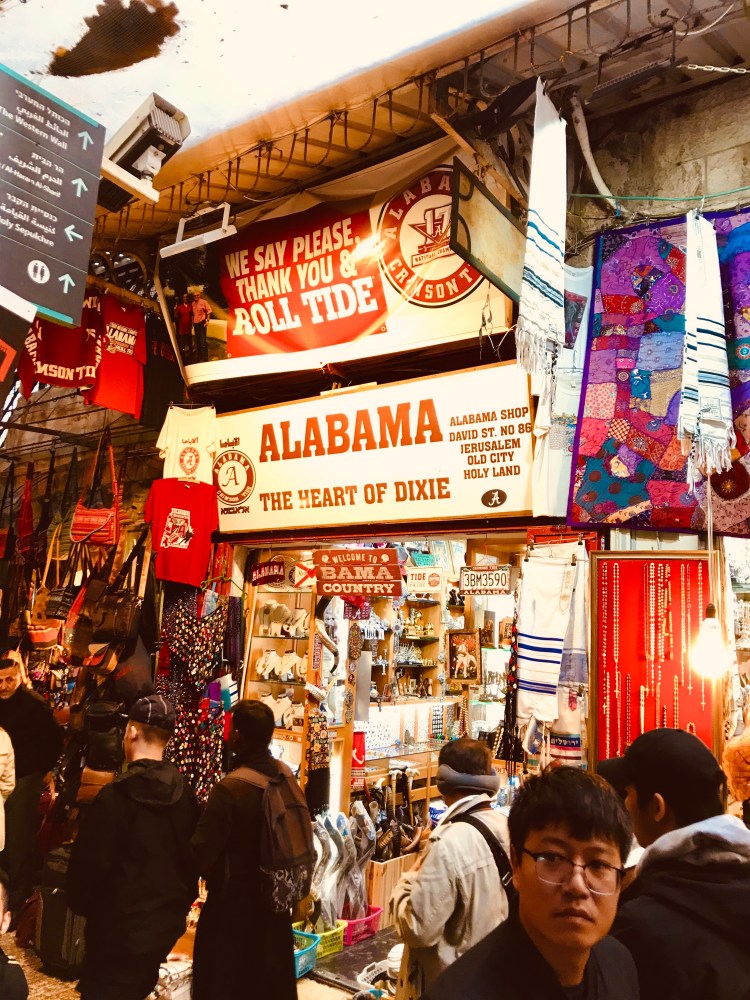 {You could find almost anything in the market. How about that?}
After a two and a half hour journey towards home, with tips texted to me by Dave while I used the visitor center WiFi one more time, I found myself back at the AirBnB in Tel Aviv. The boys were happily playing on their new Nintendo Switch and Dave had popped out to the market for food and had made dinner. A nice ending to a very special day.
We had concluded an epic trip to Israel. The next day we headed back to Germany.
Visiting Israel was a very intense and eye-opening experience. While I realize I only scratched the surface, I was drawn to the country and hope to go back again while we are living in Europe. I hope you have enjoyed my retelling of our time there.
 Berlin Lubells: Stories of Life in Berlin from an American Expat Mom's First Experience Living Abroad